Gallery Wall Frame Sets: Styling Tips, Frame Finishes & Room-by-Room Ideas

Gallery wall frame sets help create a cohesive, artful display by unifying size, finish, and spacing. They are especially useful when you want a room to feel collected, personal, and easy to style over time.
Gallery wall frame sets do more than hold images—they set the rhythm of a room. Chosen well, they create a visual story that feels collected, personal, and quietly intentional, whether you are styling a living room, refreshing a hallway, or choosing a meaningful gift.
- Start with scale: Match frame size to wall width, furniture, and ceiling height.
- Choose a visual thread: Keep one shared element, such as colour, finish, or subject matter.
- Think about light: Reduce glare and protect paper-based art from strong sun.
- Use sets for cohesion: They simplify styling and create a more polished result.
Gallery Wall Frame Sets: How They Shape a Room’s Visual Story
A gallery wall works best when the frames feel related, even if the artwork inside them varies. That sense of coordination helps the eye move comfortably across the wall and gives the display a finished, editorial quality rather than a piecemeal look.
For many interiors, gallery wall frame sets are the simplest way to achieve that balance. They bring consistency in colour, profile, and proportion, while still leaving room for personality through prints, photographs, sketches, and keepsakes.
Why coordinated frames matter in art-led interiors
Coordinated frames help anchor a room’s palette and visual language. In an art-led interior, they can either quiet a busy collection or sharpen a minimal one, depending on the finish and scale you choose.
They also reduce decision fatigue. Instead of matching each frame individually, a set gives you a starting point that already feels cohesive. That is especially useful when you are styling a wall over time rather than all at once.
Reader intent: choosing a set for display, styling, or gifting
People usually search for gallery wall frame sets with one of three goals in mind: to display a growing collection, to style a room more thoughtfully, or to give a present that feels personal and lasting. Each goal changes what “best” means.
If you are buying for yourself, think in terms of room scale and the story you want the wall to tell. If you are gifting, consider versatility, neutral finishes, and easy-to-love formats that suit a range of interiors.
When in doubt, choose a set with one dominant finish and one subtle accent. That keeps the wall unified while still giving it depth.
Choosing the Right Gallery Wall Frame Set for Your Space
The right set depends as much on architecture as on taste. A small wall in a narrow corridor asks for a different approach than a tall living room wall above a sofa or a studio space filled with natural light.
Matching frame size to wall scale and ceiling height
Large walls can handle larger frames, wider spacing, or a more expansive arrangement. Smaller rooms often benefit from tighter groupings and slimmer profiles, which keep the display from feeling heavy.
Ceiling height matters too. In rooms with higher ceilings, vertically oriented frames or stacked arrangements can draw the eye upward. Lower ceilings usually look calmer with horizontal lines and a more grounded layout.
- Wall width and available negative space
- Furniture below the display, such as a sofa or console
- Ceiling height and sightlines from the doorway
- Whether the set should feel bold, subtle, or balanced
Landscape, portrait, and mixed-format arrangements
Landscape frames are often ideal above furniture because they echo the horizontal line of a sofa, bed, or sideboard. Portrait frames work beautifully in hallways and narrow walls, where they add lift and elegance.
Mixed-format sets feel more collected and relaxed. They suit homes that lean eclectic or layered, especially when the content includes family photographs, travel prints, and small artworks with different proportions.
Best room-by-room uses: living rooms, hallways, bedrooms, and creative studios
Living rooms usually benefit from a set that feels composed and welcoming, especially if the wall is visible from multiple angles. Hallways can handle repetition and rhythm, making them ideal for sets that create a gentle sequence as you walk past.
Bedrooms often call for softer, quieter combinations—muted tones, calming imagery, and frames that do not dominate the room. Creative studios can be more playful, with mixed media, sketches, and evolving displays that reflect process as much as finished work.
A gallery wall does not need to be symmetrical to feel balanced. It only needs a clear visual logic, such as consistent spacing, repeated finishes, or a shared colour story.
Style Directions: Minimal, Classic, Eclectic, and Curated Salon Walls
Style is where gallery wall frame sets become especially expressive. The same print can feel modern, traditional, or romantic depending on whether it is surrounded by black, white, wood, or metallic frames.
Black, white, wood, and metallic finishes compared
Black frames tend to sharpen artwork and create contrast, which is particularly effective for photography, monochrome prints, and graphic pieces. White frames feel airy and understated, often working well in bright rooms or soft, coastal-inspired spaces.
Wood finishes bring warmth and an organic quality. They are especially appealing when you want the wall to feel lived-in rather than formal. Metallic finishes, by contrast, add a touch of polish and can lift a display that needs a little more light-catching detail.
| Option | Best For | Note |
|---|---|---|
| Black | Photography, modern prints, graphic art | Creates crisp contrast and a gallery-like feel |
| White | Light rooms, soft palettes, airy interiors | Subtle and unobtrusive, especially on pale walls |
| Wood | Warm, natural, relaxed rooms | Brings texture and a collected, timeless mood |
| Metallic | Elegant, reflective, more formal displays | Best used sparingly for balance rather than excess shine |
When to choose symmetry versus an intentionally layered layout
Symmetry is ideal when you want calm and order. It works well in formal living rooms, above beds, or in spaces where the wall needs to feel visually settled.
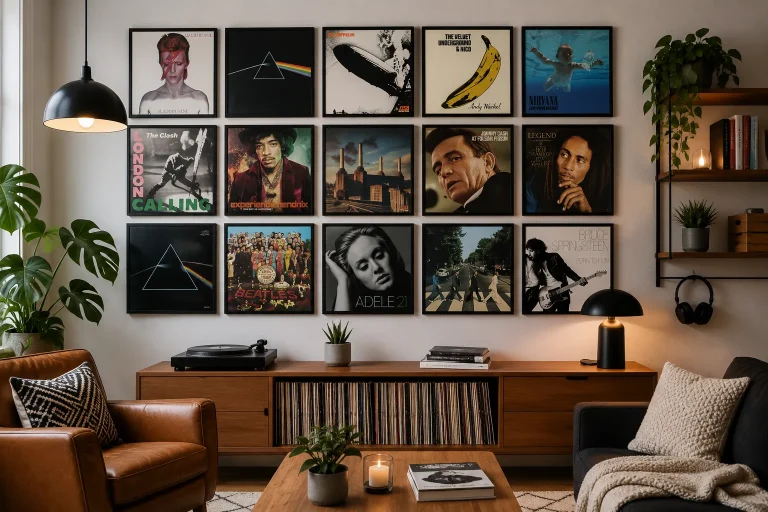
An intentionally layered layout feels more editorial and personal. It suits collections that are still growing, especially when combining different sizes, subjects, or frame finishes. If you enjoy a slightly curated-salon feel, this approach can be very rewarding. For a related styling idea, see our guide on how to create a record cover gallery wall.
How frame colour changes the mood of prints, photographs, and artwork
Frame colour affects how the artwork reads at a glance. Dark frames intensify contrast and can make lighter images feel more dramatic, while pale frames soften edges and encourage a gentler, more spacious impression.
Wood tones can make portraits and botanical prints feel warmer and more intimate. Metallics can elevate line drawings, vintage imagery, or special-occasion photographs without overpowering them. If you are styling a display of personal images, the frame colour should support the emotion of the content rather than compete with it.
What to Put Inside: Art Prints, Family Photography, Books, and Keepsakes
The strongest gallery walls usually have a theme, even if it is not obvious at first glance. That theme might be colour, memory, subject matter, or a shared sense of mood.
Building a cohesive story with mixed media
Mixed media can be beautiful when there is a unifying thread. A wall might combine line drawings, book pages, small photographs, and one or two sentimental objects, as long as the scale and spacing feel deliberate.
One useful rule is to repeat at least one element across the set: a frame colour, a mat style, a paper tone, or a visual subject such as landscapes, architecture, or family moments. That repetition keeps the wall from feeling random.
Using gallery wall frame sets for travel memories, children’s art, or giftable collections
Gallery wall frame sets are especially useful for travel memories because they turn postcards, maps, ticket stubs, and photographs into something more enduring. The same idea works beautifully for children’s art, which often deserves a more elevated presentation than a pinboard can give.
They also make thoughtful gifts when the recipient enjoys collecting. A set filled with meaningful images, quotes, or small works can feel much more personal than a single decorative object. If you are weighing a framed gift against another art-related present, our piece on art book gift vs wall decor gift may help clarify the choice.
Curator recommendations for balancing subject matter and negative space
Negative space matters as much as the art itself. A wall packed too tightly can feel restless, while too much blankness can make the arrangement seem unfinished.
Curatorially, it helps to alternate stronger images with quieter ones. Let one or two pieces carry the visual weight, and allow the others to breathe. That balance creates a display that feels thoughtful rather than crowded.
For a versatile family wall, choose a set with mixed sizes, slim frames, and generous matting. It gives photographs and small prints a sense of importance without making the arrangement feel heavy.
Lighting, Placement, and the Art of Viewing
Even the best-framed pieces can fall flat without good lighting. A gallery wall should be visible, but it should also be comfortable to live with throughout the day and into the evening.
Natural light versus artificial light for framed displays
Natural light brings freshness and clarity, but it can also be unpredictable. Direct sun may fade paper, strain pigments, and create glare on glazing, so placement matters more than brightness alone.
Artificial light offers more control. Warm ambient lighting can make a framed wall feel inviting at night, while targeted accent lighting can highlight special pieces without washing out the whole display.
Reducing glare with positioning and glass choice
Glare is one of the most common frustrations with framed displays. Positioning frames slightly away from direct windows, lamps, or overhead reflections can make a significant difference.
Glass choice also matters. Clear glazing can look crisp, while anti-reflective options may be preferable in bright rooms or on walls opposite windows. If you are framing photography or delicate artwork, it is worth considering how the surface will read at different times of day.
Pairing gallery walls with lamps, picture lights, and ambient room lighting
A gallery wall feels most complete when it belongs to the room’s broader lighting scheme. Table lamps, wall sconces, and picture lights can all help shape the mood around the display.
Soft ambient light usually works best for living spaces, while picture lights can add a more formal or library-like character. For those who enjoy layered interiors, the pairing of art and warm lighting often matters as much as the frames themselves.
Think of the wall as a quiet exhibition in your home: not overlit, not underplayed, but gently revealed in layers of evening light.
Price Context and Quality Cues in 2026
Price varies widely depending on materials, finish, glazing, and whether the set is ready-made or custom. In 2026, the most useful way to shop is by quality cues rather than by price alone.
What to expect at entry-level, mid-range, and premium price points
Entry-level gallery wall frame sets often focus on accessibility and convenience. They can work well for casual displays, temporary arrangements, or rooms where you want to experiment before investing more heavily.
Mid-range sets usually offer stronger finish consistency, better matting, and a more polished look overall. Premium or investment pieces tend to justify themselves through materials, craftsmanship, glazing quality, and long-term durability, especially for artworks you plan to keep on view for years.
Materials that influence longevity: timber, metal, mount board, and glazing
Timber frames bring warmth and can age beautifully when well made. Metal frames often feel slimmer and more contemporary, which suits modern interiors and photography-led walls.
Mount board affects presentation as much as appearance, especially for prints and works on paper. Glazing matters too: standard glass is common, but higher-quality options can improve clarity and help protect more delicate pieces from dust and handling.
When investing in a set makes more sense than buying frames individually
Buying a set often makes sense when consistency is the priority. If you want a unified wall with matching proportions and finishes, a coordinated set saves time and reduces the risk of mismatched tones or profiles.
Individual frames can be better for highly eclectic displays or for slowly building a collection over time. But if your goal is a polished, cohesive result, a well-chosen set usually offers the cleaner visual outcome.
Care, Hanging, and Long-Term Display Maintenance
A beautiful gallery wall should also be practical to live with. Good hanging, sensible cleaning, and a little preventive care will help the display stay elegant over time.
Safe hanging methods for plaster, brick, and stud walls
Different wall types need different fixings. Plasterboard often requires appropriate anchors, brick may need masonry fixings, and stud walls are best secured into the stud where possible for extra stability.
If the set is heavy, do not rely on adhesive hooks alone unless the product is specifically designed for that load and wall surface. A secure installation protects both the frames and the artwork inside them.
Use paper templates or measurements to test spacing before making any holes.
Choose the right anchors, screws, or hooks for plaster, brick, or stud construction.
Small inconsistencies become obvious once multiple frames are grouped together.
Cleaning frames, glass, and mounts without damaging artwork
Dust frames gently with a soft, dry cloth. For glass, use a cleaner sparingly and avoid spraying directly onto the frame, especially near openings where moisture could seep inside.
Mounts should be kept dry and handled carefully. If you need to remove artwork, do so in a clean, stable space and avoid touching the image surface more than necessary.
Protecting displays from dust, humidity, and direct sunlight
Humidity can warp paper, affect mounts, and encourage mould in poorly ventilated spaces. Bathrooms and kitchens may need extra caution unless the display is specifically protected and the room conditions are stable.
Direct sunlight is another major concern, especially for photographs, watercolours, and works on paper. Rotating sensitive pieces or using more protected glazing can help preserve colour and condition. For displays that include original drawings or painted work, our guide to drawing pencil sets for fine art beginners may be useful if you are framing your own practice pieces.
Paper-based artwork is vulnerable to light, dust, and moisture. If a piece is especially sentimental or valuable, consider archival materials and a wall position away from direct sun.
A Creative Recap: Building a Gallery Wall That Feels Collected, Personal, and Timeless
Gallery wall frame sets are at their best when they make a room feel like it has been assembled with care over time. They can be minimal or layered, formal or relaxed, but the most memorable displays always feel considered.
Key takeaways for styling with confidence
Start with the room, not just the frames. Scale, light, and furniture placement should guide your choices as much as colour or style.
Then decide what story the wall should tell. A strong gallery wall can centre family photographs, favourite prints, books, travel memories, or a mix of all four—as long as the arrangement has a clear visual thread.
How gallery wall frame sets support evolving interiors and meaningful gifting
One of the quiet strengths of gallery wall frame sets is their flexibility. They can evolve as your taste changes, as your collection grows, or as a home moves from one chapter to the next.
That makes them especially useful for gifting too. A well-chosen set can feel both practical and sentimental, offering the recipient a beautiful starting point for a display that becomes more personal with time.
Recommended Products
SHOP THIS SETUP
Umbra Exhibit Picture Frame Gallery Set, Black
This set stands out for its clean, modern presentation and flexible layout, making it ideal for creating a polished gallery wall with minimal effort. The coordinated frames help art prints, photos, and mixed media feel intentional and cohesive, which is especially useful for styling a living room, hallway, or home office.
Frequently Asked Questions
Start with wall size, ceiling height, and the type of artwork you want to display. It also helps to think about frame finish, glazing, and whether you want a neat or more layered look.
They often are if you want a cohesive display without mismatched finishes or proportions. Individual frames can work better for eclectic walls or when you are building a collection slowly.
Black is a classic choice because it adds contrast and keeps photographs looking crisp. White or wood can feel softer, depending on the mood you want in the room.
Place the wall away from direct windows and strong overhead reflections where possible. Anti-reflective glazing can also help in bright rooms.
Yes, and they can make children’s drawings or keepsakes feel especially cherished. Choose frames with enough depth and protection for the materials you plan to display.
Keep frames dusted, avoid excess humidity, and protect paper-based pieces from direct sunlight. For valuable or sentimental work, archival materials are worth considering.