Coffee Table Book Collector Signs: When a Stack Becomes a Collection

The best way to store coffee table books is flat or upright on a stable shelf, away from direct sunlight, heat sources, and humidity — keeping covers protected and spines intact so each book remains beautiful for decades.
Store coffee table books flat in small stacks of no more than three, or upright between bookends on a solid shelf. Keep them away from windows, radiators, and damp rooms. Use acid-free tissue or cotton gloves for valuable editions, and rotate displayed books regularly to prevent uneven fading. Proper storage protects both the physical book and the investment it represents.
I have moved apartments three times in the past decade, and every time, the coffee table books are the ones I handle most carefully. Not the fragile ceramics, not the framed prints — the books. Because I know from experience that a poorly stored book does not announce its damage immediately. It happens slowly: a warped cover here, a faded spine there, a dust jacket that finally gives up.
Most people think about how their books look on display. Far fewer think about what happens to them when they are not on display — tucked into a shelf, stacked in a cupboard, or waiting in a spare room between seasons. That is where the real care happens, or fails to happen.
In this guide, I am going to share everything I have learned about storing coffee table books properly. Whether you have two books or twenty, these habits will keep them in the condition they deserve.
What Coffee Table Book Storage Actually Means
Storing a coffee table book is different from storing a paperback novel. These are large-format, heavy, often cloth or paper-covered volumes with high-quality printed pages and dust jackets that can be delicate. The materials used to produce them respond to their environment in ways a mass-market book does not.
Good storage means controlling three things: light, temperature, and humidity. Get those right and a coffee table book can remain in near-perfect condition for thirty years or more. Get them wrong and you may open a book after a single winter to find warped boards, faded color, or a cover that smells faintly of damp.
Many major institutions, including The Getty Museum, recommend storing large-format art books horizontally rather than vertically when the spine is under stress from the book’s own weight. This is especially relevant for very heavy volumes like museum catalogues and monographs.
A coffee table book stored with the same care as the art it depicts will outlast every trend, every redecoration, and every passing style. It becomes an heirloom. Hurrell Editions editorial perspective
Why Proper Storage Matters for Your Collection
There is a common assumption that books are durable objects — that they can look after themselves. For most books, that is broadly true. For coffee table books, it is not. The combination of heavy coated paper, large format boards, and often delicate dust jackets makes them more vulnerable than they appear.
Poor storage causes problems that are very difficult to reverse. A warped cover caused by humidity cannot be fully flattened at home. UV fading on a linen cloth cover cannot be undone. Mould that develops in a damp cupboard can spread to neighboring books within weeks. Prevention is genuinely the only strategy that works.
Picture a deep linen cupboard with two shelves cleared for books. Volumes stand upright between a pair of simple brass bookends, spines facing out. A few larger editions lie flat beneath. The light inside is dim, the air is dry, and the door closes softly. When you open it six months later, every book looks exactly as it did the day you bought it. That is what thoughtful storage makes possible.
For storing books that are not on display, I use a dedicated shelf in my studio — away from the window, away from the radiator, and away from the kitchen. The shelf is solid wood, the books stand upright between bookends, and the heaviest volumes lie flat in pairs. Nothing complicated. The discipline is simply in choosing the right spot and committing to it consistently.
How to Store Coffee Table Books Properly
These steps apply whether you are storing one book between seasons or organising a growing collection on permanent shelving. Follow them in order the first time, then they become second nature.
Select a spot that is dry, stable in temperature, and away from direct sunlight. An interior wall shelf, a dedicated cupboard, or a shaded alcove all work well. Avoid external walls in cold climates, attics, basements, and rooms that experience significant humidity — bathrooms and kitchens are unsuitable for any book storage.
Flat storage is best for very large, very heavy books — museum catalogues, Taschen editions, and large-format photography monographs. Upright storage works well for mid-sized volumes if they are supported on both sides. Never store a heavy book upright without bookends — the spine will gradually distort under its own weight.
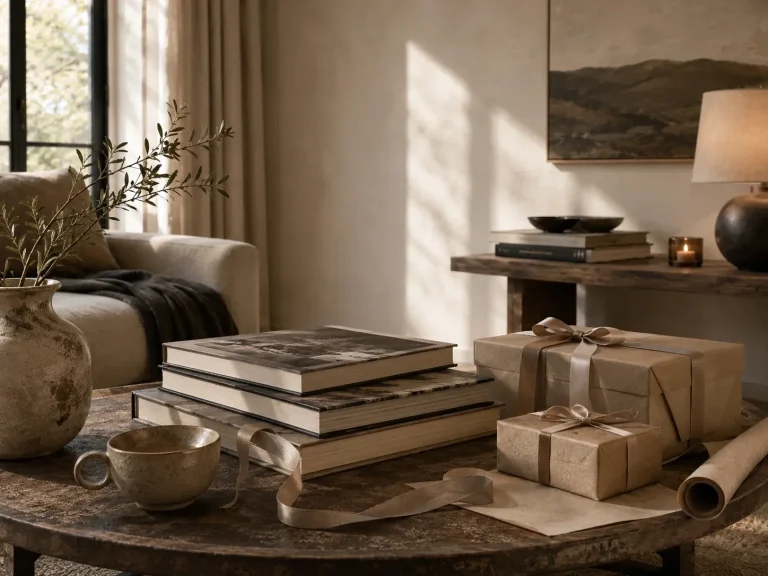
When stacking flat, always place the largest and heaviest book at the bottom and the lightest on top. Three books is a safe limit — beyond that, the pressure on the lowest volume can cause cover deformation over time, particularly on cloth-covered or embossed boards.
If a book has a dust jacket you want to preserve, wrap it in a loose sheet of acid-free tissue before placing it on the shelf. Alternatively, remove the jacket entirely, store it flat in an acid-free folder, and replace it when the book returns to display. This prevents friction damage and dust accumulation on delicate jacket surfaces.
Do not pack books tightly together on a shelf — leave a finger’s width of space between each volume. This allows air to circulate and prevents moisture from becoming trapped between covers, which is one of the most common causes of cloth and paper cover deterioration.
A light dusting every month with a dry, clean microfibre cloth keeps grime from building up on cover surfaces and spine edges. Dust accumulation combined with humidity is a reliable recipe for mould — especially on cloth-covered volumes where dust can become embedded in the weave.
If you have more books than display space allows, rotate them on a seasonal basis. Books that spend months in storage get brought out; displayed books go to rest. This keeps every book in use and appreciated, prevents any single volume from accumulating too much light exposure, and refreshes the feeling of your space at no extra cost.
If you store books in a cupboard or box during a move or renovation, place a small silica gel packet nearby to absorb ambient moisture. These cost almost nothing, last for months, and prevent the humidity fluctuations that cause covers to warp during transit or extended storage.
Best Storage Products for Coffee Table Books
You do not need to spend much to store books well. The essentials — bookends, acid-free tissue, and a good shelf — can be sourced for very little. Where it is worth spending more is on the shelf itself, since the structural integrity of your storage directly affects how safely books are held over time.
For more ideas on how to curate and display your collection when books are not in storage, our coffee table book collection covers styling, display, and choosing books with lasting visual impact.
| Book Type | Best Storage Position | Max Stack / Group | Special Care |
|---|---|---|---|
| Very large format (14″+ wide) | Flat on solid shelf | 2 books maximum | Support full cover surface — no overhang |
| Standard coffee table book (10–12″) | Flat or upright with bookends | 3 books flat or 6–8 upright | Acid-free tissue for cloth covers |
| Museum catalogue / monograph | Flat preferred | 2–3 maximum | Remove dust jacket for long-term storage |
| Slim design volume (under 1″ thick) | Upright between bookends | Up to 10 upright | Ensure bookends are tight — slim books tilt easily |
| Signed or limited edition | Flat, individually wrapped | 1 per layer | Acid-free tissue + cotton gloves when handling |
| Box set or slip-case edition | Flat in slip case | 1 set per layer | Keep slip case closed — it protects the books inside |
Tips From Experience
These are the habits I have developed over years of moving, displaying, and rotating a personal collection. None of them require special equipment or significant expense — just attention and consistency.
- Never store books directly on a cold stone or concrete floor — condensation forms beneath them over time, and moisture damage is often invisible until it is severe.
- If you are storing books during a house move, wrap them individually in clean cotton or acid-free tissue before boxing. Books shifted loosely in boxes develop edge and corner damage that accumulates with every move.
- For cloth-covered volumes, check covers every few months during storage for any sign of mould or foxing — small reddish-brown spots that indicate humidity damage. Caught early, they can sometimes be addressed; left untreated, they spread.
- Label stored books on the outside of their wrapping so you never have to unwrap and handle them unnecessarily when looking for a specific title.
- When bringing a book out of storage into a warm room, allow it to acclimatise for an hour before opening. Moving from cold storage to warm air too quickly can cause condensation inside the covers.
Common Mistakes to Avoid
Most storage damage is avoidable. The mistakes below are the ones I see most often — and the ones that cause the most irreversible harm to beautiful books.
- Store on solid, stable shelving with bookends for upright books
- Keep books in a climate-stable interior room away from windows
- Limit flat stacks to three volumes with the heaviest at the base
- Dust covers monthly with a dry microfibre cloth
- Use acid-free tissue for valuable or delicate editions
- Allow a finger’s width of air space between upright volumes
- Rotate books between display and storage every season
- Storing books near radiators, underfloor heating vents, or fireplaces
- Placing books in direct or indirect sunlight for extended periods
- Stacking more than three books flat — pressure warps the lowest covers
- Storing in basements, attics, or bathrooms where humidity fluctuates
- Packing books tightly together with no air circulation
- Leaving heavy books upright without bookend support on both sides
- Wrapping books in regular plastic — it traps moisture against covers
Care and Preservation for Long-Term Storage
Long-term storage requires a slightly more considered approach than simply finding an empty shelf. For any book you expect to store for more than a few months, these preservation practices make a measurable difference to the condition it will be in when you return to it.
Never wrap coffee table books in standard plastic wrap or cling film for storage. Plastic traps moisture against the cover, which accelerates exactly the kind of warping, mould, and adhesive breakdown you are trying to prevent. For protective wrapping, always use acid-free tissue or unbleached cotton. This is especially critical for signed, limited edition, or archival-quality volumes where the cover material is irreplaceable.
For collectors who own museum catalogues, limited edition prints in book form, or signed monographs, it is worth reading Smithsonian Magazine’s arts coverage on conservation and archival care — the principles used for fine art apply directly to high-value illustrated books.
- Climate-stable room, 40–70°F, 30–50% humidity
- Solid shelf with bookends for upright books
- Acid-free tissue for cloth and delicate covers
- Monthly dusting with a dry cloth
- Silica gel packets for enclosed storage spaces
- Cotton gloves when handling rare or signed editions
- Storage near heat sources or in direct sunlight
- High humidity rooms — kitchens, bathrooms, basements
- Standard plastic wrapping that traps moisture
- Stacking too many books flat without size order
- Storing on the floor, especially stone or tile surfaces
- Ignoring signs of mould, foxing, or cover distortion
| Storage Location | Risk Level | Main Hazard | What to Do Instead |
|---|---|---|---|
| South-facing windowsill or shelf | High | UV fading, cover bleaching | Move to a shaded interior shelf immediately |
| Beside a radiator or heat vent | High | Drying, spine cracking, glue failure | Keep at least 60cm from any heat source |
| Basement or attic | High | Humidity fluctuation, mould, pests | Use only climate-controlled interior rooms |
| Kitchen shelf | Medium-high | Grease, steam, humidity spikes | Relocate to living room or studio shelving |
| Interior bedroom shelf | Low | Minor dust accumulation | Dust monthly, allow air circulation |
| Dedicated book cupboard, interior wall | Very low | Occasional darkness — no UV risk | Ideal for long-term storage with silica packets |
- Store coffee table books flat in stacks of three or fewer, or upright with solid bookend support on both sides.
- Choose a climate-stable interior room — away from sunlight, heat, and humidity.
- Use acid-free tissue for valuable or cloth-covered editions, never standard plastic.
- Dust covers monthly and allow a finger’s width of air circulation between upright volumes.
- Rotate books between storage and display each season to prevent uneven fading and keep every title appreciated.
- Add silica gel packets to enclosed storage spaces to control moisture during long-term storage.
How you store your coffee table books matters as much as how you display them. A book kept in the right conditions — cool, dry, supported, and away from light — will remain as beautiful in twenty years as it is today. The care you give it now is the reason a future you, or someone else entirely, will still be able to open it and feel something.
Frequently Asked Questions
Very large and heavy books — anything over 12 inches wide or significantly weighty — are better stored flat to prevent the spine from distorting under the book’s own weight. Mid-sized volumes can be stored upright if they have solid bookend support on both sides. Never store any book upright without support, as the spine will gradually lean and warp.
Three books is the safe maximum for flat stacking. Always place the largest and heaviest volume at the base. Beyond three books, the pressure on the lowest volume can cause cover boards to deform over time, particularly on cloth-covered or embossed editions.
For everyday storage, a dust-free shelf with air circulation is sufficient. For valuable, signed, or delicate cloth-covered editions, wrap loosely in acid-free tissue paper before placing on the shelf. Remove dust jackets and store them flat in acid-free folders if you want to preserve them in the best possible condition during long-term storage.
Avoid basements, attics, bathrooms, and kitchens — all are prone to humidity fluctuation, which warps covers and encourages mould. Never store books in direct sunlight, beside radiators, or near any heat source. Cold stone or concrete floors are also unsuitable as condensation can form beneath books stored at floor level.
No. Standard plastic wrapping traps moisture against the cover, which can cause warping, adhesive failure, and mould growth — the opposite of what you want. For protective wrapping, always use acid-free tissue paper or clean, unbleached cotton cloth, both of which breathe while still protecting surfaces from dust and friction.
Wrap each book individually in acid-free tissue or clean cotton before boxing. Place books flat in sturdy boxes, heaviest at the bottom, and do not overfill — books should not shift during transit. Label boxes clearly and load them last so they are unloaded first and not crushed under heavier items. Add silica gel packets inside sealed boxes to control humidity during the move.
Every two to three months is a reasonable interval. Look for any sign of mould — small reddish-brown spots called foxing — and check that covers have not begun to warp or smell damp. Dust the shelf and the top edges of the books, and replace any silica gel packets that have become saturated. Books in stable, dry conditions need very little intervention once properly set up.
Final Thoughts
Storing coffee table books well is one of the quieter ways of showing that you take your collection seriously. It does not require expensive equipment or specialist knowledge — just a few consistent habits applied to the right environment. A cool, dry, stable shelf with good bookend support is genuinely enough for most collections.
If you are building a collection worth storing, our Books & Gifts section has ideas for finding titles worth adding — books that are as beautiful to look at as they are to read. And if display is on your mind too, the Creative Living section explores how artful books, objects, and lighting come together to make a home feel genuinely considered.
The books you choose and care for now are the ones that will still be on your shelves in twenty years — beautiful, intact, and meaningful. That is worth a little attention.
— Julian