Can Gallery Picture Lights Be Used Outdoors

Yes, gallery picture lights can be used outdoors if they are specifically rated for exterior use and installed in a suitably sheltered location. Most indoor picture lights should not be used outside because moisture, corrosion, and safety issues can shorten lifespan or create risk.
Can gallery picture lights be used outdoors? Yes, but only when the fixture is specifically designed or clearly rated for exterior conditions and the installation location matches that rating. For most homes, the real question is not whether a picture light can survive outside, but whether the wall is sheltered enough, the finish is durable enough, and the light quality is good enough to flatter art after dark.
Outdoor picture lighting sits at the intersection of decor and durability. A well-chosen fixture can turn a covered porch, pool house, or garden room into a more polished entertaining space, but the wrong light can corrode quickly, trap moisture, create glare, or fail early. If you are considering a gallery-style light for an exterior wall, the details that matter most are weather rating, material quality, beam control, and placement.
- Rating matters: Choose damp-rated or wet-rated fixtures based on actual exposure.
- Best locations: Covered porches, verandas, garden rooms, and sheltered courtyards are ideal.
- Material choice: Brass, stainless steel, and quality powder-coated finishes tend to hold up better outdoors.
- Light quality: Look for good beam control, suitable brightness, and a color temperature that matches nearby.
- Avoid shortcuts: Adapting an indoor picture light for exterior use is usually a poor long-term choice.
Can gallery picture lights be used outdoors? The short answer
They can, but only in the right circumstances. A true outdoor-safe gallery picture light is usually built with sealed components, corrosion-resistant materials, and a rating that tells you whether it can handle damp air, splashes, or direct weather exposure.
When outdoor use is possible and when it is not
Outdoor use is possible when the fixture is labeled for exterior use and installed in a location that matches the manufacturer’s guidance. Covered porches, enclosed verandas, garden rooms, and sheltered courtyards are the most realistic candidates because they reduce direct exposure to rain, standing moisture, and harsh sun.
Outdoor use is usually not appropriate when a standard indoor picture light is being adapted for a fully exposed wall. It is also a poor fit where wind-driven rain, salt air, irrigation spray, or frequent condensation are part of daily life. In those settings, even a decorative fixture that looks sturdy may not hold up well.
Why most indoor picture lights should never be installed outside
Most indoor picture lights are made for climate-controlled rooms. Their finishes may not be sealed for moisture, their electrical components may not be protected from water intrusion, and their metal parts may tarnish or rust faster than expected outdoors.
There is also a safety issue. A fixture that is not rated for exterior conditions can become unreliable or hazardous when exposed to dampness. Even if the light turns on initially, that does not make it suitable for long-term outdoor use. When in doubt, check the official product listing, installation instructions, and rating details rather than relying on appearance alone.
Some decorative wall lights resemble picture lights but are engineered more like outdoor sconces. If a product is marketed for artwork illumination, verify whether the outdoor rating applies to the whole fixture and not just the LED module.
What to look for in an outdoor-safe gallery picture light
IP rating, damp-rated vs wet-rated construction, and weather resistance
The first filter is the rating. Damp-rated fixtures are generally intended for protected exterior locations where moisture is present but direct rain is limited, such as a covered porch. Wet-rated fixtures are built for more direct weather exposure. If the wall is not fully sheltered, wet-rated construction is the safer category to look for.
An IP rating offers additional clarity by indicating resistance to solids and moisture. The exact number needed varies by location, but the principle is simple: the more exposed the fixture, the more important a stronger weather-resistance rating becomes. If a retailer omits this information, it is worth treating that omission as a caution sign.
Materials that last outdoors: brass, powder-coated metals, stainless steel, and sealed finishes
Material choice matters almost as much as the rating. Brass is often favored for classic picture light styling and can age attractively, but the way it patinas outdoors depends on the finish and local climate. Powder-coated metals can offer a cleaner contemporary look and better finish stability when properly made. Stainless steel is often a practical choice in modern settings, especially where moisture is frequent.
Look for language around sealed finishes, corrosion resistance, and exterior-grade hardware. Decorative coatings that perform well indoors may break down much faster outside, particularly on sunny or coastal walls. If you are pairing the fixture with framed art, the frame finish matters too; rustic or timber styles may complement the setting, but they also need to suit the climate.
LED quality, colour temperature, CRI, and glare control for art illumination
A picture light should do more than survive the weather. It should also make the artwork look good. For exterior art lighting, LED is usually the most practical choice because it runs efficiently, produces less heat than older bulb types, and is widely available in compact integrated designs. If you are comparing lamp styles, Hurrell Editions also has a guide to LED picture light options that explains why LED has become the default for modern art lighting.
Color temperature affects mood. Warm white often feels more inviting on porches and outdoor dining walls, while neutral white can look cleaner and more architectural. CRI, or color rendering index, indicates how accurately colors appear under the light. For artwork, a higher CRI is generally preferable because it helps prints, painted surfaces, and mixed materials look more natural.
Glare control is easy to overlook. Outdoors, the contrast between darkness and a bright fixture can make glare more obvious than it is indoors. A light with a shielded beam, diffuser, or adjustable head is often easier to live with than one that throws a harsh hotspot onto glass or polished frames.
Power source options: hardwired, plug-in, low-voltage, solar, and rechargeable designs
Hardwired picture lights are usually the cleanest-looking option for permanent installations, but they require the right location and often professional help. Low-voltage systems can be useful in garden rooms or covered entertainment spaces where a broader outdoor lighting plan is already in place.
Plug-in models are less common outdoors because cords and outlets create additional weather and safety considerations. Rechargeable and battery-operated styles can be appealing in rental-friendly or wiring-averse spaces, but they still need to be rated for the environment. If you are weighing convenience against maintenance, it helps to read more about whether battery-operated picture lights are any good and how charging needs affect day-to-day use.
Solar designs exist, though they are not always ideal for true gallery-style lighting. They can be inconsistent where sunlight is limited, and many prioritize pathway-style output over refined art illumination. For a curated exterior wall, solar may work best as a practical compromise rather than a first-choice design solution.
Safety basics for exterior installation in 2026
In 2026, the fundamentals remain straightforward: exterior fixtures should match the location rating, wiring should comply with local code, and any hardwired installation should be handled with appropriate caution. If there is any uncertainty about wall type, weather exposure, or electrical safety, a qualified electrician or installer is the sensible next step.
It is also wise to confirm whether the artwork itself is suitable for outdoor display. A weather-safe light will not protect a paper print, standard backing board, or unsealed frame from humidity damage.
- Confirm the fixture is rated for the exact outdoor location.
- Check the finish, hardware, and corrosion-resistance details.
- Verify beam direction, color temperature, and whether glare control is built in.
- Make sure the artwork and frame are also suitable for exterior conditions.
Where outdoor picture lights work best around the home
Covered porches, garden rooms, loggias, verandas, and exterior dining areas
These are usually the best settings because they combine shelter with visibility. A picture light above a framed botanical print, ceramic plaque, or decorative mirror can make an outdoor sitting area feel more intentional and finished. In a covered dining zone, the effect is often less about museum-style precision and more about giving the wall a warm focal point after sunset.
Garden rooms and loggias also tend to have more stable conditions than open patios. Reduced rain exposure means a broader range of outdoor-rated fixtures may be viable, and art lighting can become part of the overall mood rather than fighting the elements.
Outdoor kitchens, pool houses, guest houses, and sheltered courtyards
These spaces often benefit from picture lights because they already function like transitional rooms. A pool house wall with framed coastal photography, an outdoor kitchen with vintage-style signage, or a guest house entry with a decorative mirror can all support the look well.
That said, each environment has its own challenge. Outdoor kitchens may introduce grease and smoke residue. Pool areas often bring humidity and chemical exposure. Guest houses may be easier because they are more enclosed, but they still need proper fixture selection if doors and windows remain open much of the season.
When exposed walls, coastal settings, and high-moisture zones are poor candidates
Some walls simply ask too much of a gallery-style fixture. A facade that takes direct rain, a beachfront terrace with salt-laden air, or a wall near sprinklers and heavy condensation can shorten the life of even decent materials. In these conditions, a dedicated outdoor wall washer or architectural sconce may be a smarter investment than a decorative picture light.
High-moisture zones also raise maintenance demands. If you want a low-fuss lighting plan, fully exposed locations are rarely the best place to experiment with art-focused fixtures.
- Use picture lights in covered, design-led outdoor rooms.
- Match the fixture rating to the real exposure level, not the idealized one.
- Think about the durability of both the light and the artwork.
- Mounting an indoor brass light on a fully exposed exterior wall.
- Assuming a roof overhang makes every porch effectively weatherproof.
- Using delicate paper art where moisture and UV are constant.
Placement, sizing, and brightness: how to light outdoor art properly
Choosing the right fixture width in relation to the frame or artwork
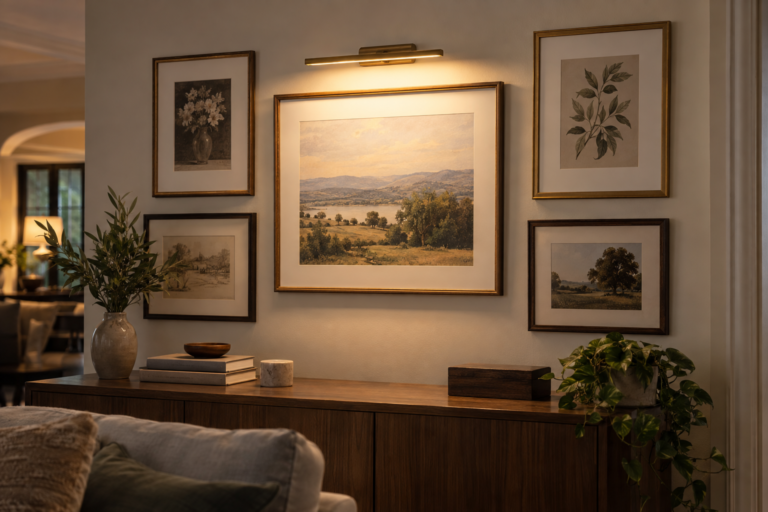
As a general design rule, the fixture should look visually proportional to the piece it lights. Many shoppers aim for a light that spans roughly half to two-thirds of the frame width, though the right ratio depends on the beam spread, the height of the fixture, and whether the art is bold or delicate.
A very small light over a wide frame can look mean and underpowered. An oversized bar can dominate the composition, especially outdoors where there are fewer surrounding surfaces to visually absorb it. If you are using a battery model for flexibility, guides to picture lights for wall battery operated setups can help clarify common size and use-case tradeoffs.
Mounting height, beam spread, and distance from the artwork
Placement affects both appearance and performance. The fixture usually sits above the frame, but the ideal distance varies by arm projection and beam angle. Too close, and you may get a bright stripe at the top. Too far, and the light can spill awkwardly onto the wall or fail to reach the lower half of the piece.
Beam spread matters more outdoors because the surrounding area is often darker. A narrow beam can create dramatic focus but may exaggerate hotspots. A wider beam tends to feel softer and more decorative. If the artwork is glazed, careful positioning is especially important to reduce reflected glare.
Brightness by setting: ambient accent lighting vs focal display lighting
Not every outdoor picture light needs to perform like a gallery spotlight. In many exterior settings, the goal is ambient accent lighting: enough output to define the wall and make the artwork readable without overpowering the rest of the space. A porch seating area usually benefits from softer illumination than a dramatic focal wall in a sheltered courtyard.
If the piece is meant to be the star, brighter output and better beam control become more important. Confirm lumen information where available, but remember that raw brightness alone does not guarantee a better result. Distribution, diffuser quality, and placement often matter just as much.
Warm white vs neutral white outdoors and how to match existing lighting
Warm white tends to feel relaxed and residential, especially when paired with lanterns, sconces, or string lighting. Neutral white often works better in minimalist spaces with stone, concrete, or crisp painted walls. The best choice is usually the one that harmonizes with the rest of the outdoor lighting rather than making the picture light look noticeably different.
Consistency matters. If every nearby fixture is warm and the picture light is cool-neutral, the artwork can feel disconnected from the setting. Likewise, if you are concerned about long-term art preservation, it is worth understanding whether LED lights fade pictures and how lower heat, sensible brightness, and good placement support safer display.
Before committing to a fixture, mock up the width with painter’s tape and view it from your main seating area at dusk. Outdoor proportions often look different once the surrounding space falls into shadow.
Styling ideas: how outdoor picture lights can elevate exterior decor
Pairing picture lights with framed prints, plaques, mirrors, and architectural details
Outdoor picture lights are not limited to framed art. They can also highlight house numbers mounted on a plaque, a decorative mirror in a covered veranda, carved stonework, or a niche with a sculptural panel. In many homes, the most successful use is not a literal painting outdoors but a durable decorative object that benefits from focused light.
Framed prints can work in protected areas if the frame, glazing, and backing are appropriate for the environment. Mirrors can be especially effective because they bounce low evening light and make compact outdoor rooms feel more layered.
Matching finishes to brick, stone, render, timber, and metal garden furniture
A good finish match helps the fixture feel integrated rather than added on. Aged brass or bronze often suits brick, natural stone, and traditional timber furniture. Matte black can look crisp against pale render or modern cladding. Stainless or muted metallic finishes often pair well with contemporary outdoor kitchens and metal dining sets.
The key is to think about the fixture as part of the whole exterior palette. If nearby hardware, planters, and furniture are all warm-toned, a cool chrome-like finish may feel abrupt unless it is repeated elsewhere.
Using picture lights within layered outdoor lighting schemes
Picture lights work best as one layer in a broader plan. They pair well with low-level path lights, wall sconces, pendant lighting in covered dining areas, and subtle landscape illumination. Used this way, they add intimacy and detail rather than trying to light the entire space alone.
Layering also helps control contrast. A single bright picture light on a very dark wall can feel theatrical in the wrong way. A softer surrounding glow makes the art feature feel intentional and easier on the eyes.
Think of an outdoor picture light as jewelry for a sheltered wall: small in scale, but capable of making the whole setting feel more refined after sunset.
Benefits, limitations, and the most common buying mistakes
The visual and practical advantages of using picture lights outdoors
The biggest benefit is atmosphere. A picture light adds a curated, finished look that standard flood or sconce lighting rarely delivers. It can make a porch feel like an extension of the interior and draw attention to art, signage, or decorative architecture that would otherwise disappear at night.
There is also a practical side. Focused lighting can improve visibility around an entry or seating wall without washing the entire area in bright general light. For design-conscious homeowners, that balance is often the appeal.
Key limitations: weather exposure, maintenance, wiring complexity, and running costs
The tradeoffs are real. Exterior-rated decorative fixtures can be more expensive than indoor versions, wiring may be more involved, and maintenance is usually higher because dust, pollen, moisture, and insects collect faster outdoors. Battery and rechargeable models reduce wiring demands but add another layer of upkeep.
Running costs vary by fixture type and how often the light is used. LED helps keep energy use reasonable, but the long-term value still depends on durability and whether the product is genuinely suited to the location.
Mistakes to avoid with sizing, colour temperature, placement, and unsuitable fixtures
One of the most common mistakes is choosing by appearance alone. A beautiful indoor-style light in a trendy finish can still be the wrong product if it lacks the right rating. Another frequent issue is selecting a fixture that is too small, too bright, or too cool-toned for the surrounding outdoor lighting.
Placement errors are just as common. Mounted too high, the light loses intimacy. Mounted too close, it creates harsh glare. And perhaps the biggest mistake of all is forgetting that the art, frame, and wall conditions matter as much as the fixture itself.
- Adds a refined, gallery-like focal point to sheltered exterior walls.
- Highlights art, plaques, mirrors, and architectural details without broad glare.
- LED outdoor models can be efficient and low-heat.
- Most indoor picture lights are unsuitable for outdoor use.
- Moisture, salt, UV, and debris can shorten lifespan.
- Installation and maintenance are often more demanding than buyers expect.
Care, maintenance, and long-term value
Cleaning lenses, checking seals, and protecting finishes through the seasons
Outdoor fixtures need periodic attention. Dust, pollen, insects, and water spotting can reduce light quality surprisingly quickly, especially on small lenses and slim bars. Cleaning should follow the manufacturer’s care instructions, with special attention to seals, joints, and exposed fasteners.
It also helps to inspect the finish seasonally. Early signs of wear, discoloration, or trapped moisture are easier to manage before they become structural problems or visible damage.
How climate, salt air, and UV exposure affect lifespan
Climate has a major effect on longevity. Dry, sheltered environments are much easier on finishes than humid or coastal ones. Salt air can accelerate corrosion, and strong UV exposure can fade coatings and age plastics or gaskets faster than many buyers expect.
Even premium fixtures age differently depending on orientation. A north-facing covered porch may be a relatively forgiving setting, while a west-facing wall with heat, glare, and weather exposure can be far tougher.
When a premium outdoor-rated fixture offers better value than adapting an indoor light
In the long run, a purpose-built outdoor fixture is usually the better value. It may cost more upfront, but it is less likely to fail early, look tired after one season, or create a mismatch between safety needs and decorative goals.
Adapting an indoor light can seem cheaper at first, yet replacement, refinishing, or troubleshooting can erase any savings. For most buyers, the more economical decision is to buy once for the right environment and confirm all specifications before ordering.
Final recommendation: when outdoor gallery picture lights are worth it
Best for design-led sheltered spaces and curated exterior walls
Outdoor gallery picture lights are most worth it in covered, intentional spaces where the wall is part of the decor experience. Think porches used for evening entertaining, garden rooms with framed decorative pieces, or sheltered courtyards where layered lighting matters. In these settings, the right fixture can add warmth, focus, and a polished residential feel that ordinary outdoor lighting does not quite achieve.
When alternative outdoor wall lighting is the smarter choice
If the wall is fully exposed, the climate is harsh, or the goal is broad practical illumination rather than art-focused ambiance, a dedicated outdoor sconce, wall washer, or architectural fixture is usually the smarter route. The best buying decision is the one that respects both the design ambition and the realities of weather, maintenance, and safety.
Frequently Asked Questions