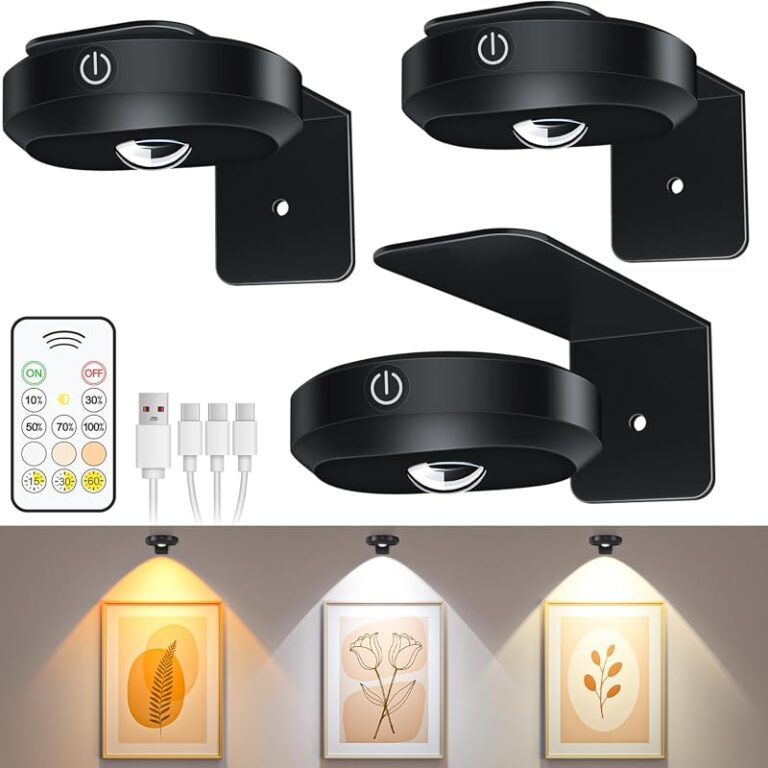
Are Battery Operated Picture Lights Any Good

Yes, battery operated picture lights can be very good for accenting small to medium artwork without wiring. They are best when you choose the right size, beam spread, and battery setup for the room.
Are battery operated picture lights any good? Yes, often surprisingly so—especially for renters, older homes, and anyone who wants to highlight framed art without calling an electrician. The key is choosing the right size, beam spread, color quality, and battery setup for the artwork rather than assuming every cordless model will perform the same way.
Battery picture lights sit in a practical middle ground between decorative accent lighting and fully wired art lighting. They can look polished, solve awkward layout problems, and make smaller walls feel more intentional, but they are not a perfect substitute for hardwired fixtures in every room. If you want a clear answer before buying, the real question is less “do they work?” and more “will this type of light suit my art, wall, and usage pattern?”
- Best fit: They work especially well in rentals, older homes, and awkward wall layouts.
- Main trade-off: You usually get less power and more battery upkeep than with wired picture lights.
- Most important spec: Beam spread matters as much as brightness for even coverage.
- Style factor: The right finish and proportion can make cordless lights look fully intentional.
- Before buying: Verify runtime, charging method, color temperature, and mounting hardware.
Are Battery Operated Picture Lights Any Good? The Short Answer for 2026
In 2026, battery operated picture lights are a good option for many homes because LED efficiency, rechargeable designs, and better remote controls have made them more practical than older cordless models. They are especially useful when you want to add focused light over one frame, a small gallery arrangement, or a shelf display without visible cords.
Where they perform well
Battery operated picture lights perform best in rooms where the goal is atmosphere, gentle highlighting, and visual focus rather than high-output illumination. A well-chosen model can make a framed print, painting, or photograph stand out beautifully in a hallway, reading nook, bedroom, or sitting room.
They are also strong performers in spaces where wiring would be inconvenient or visually disruptive. Think plaster walls in period homes, rental apartments with strict drilling rules, or narrow wall sections where a plug-in cord would look messy. In these situations, the convenience advantage is significant.
Modern cordless picture lights also tend to work well for:
- Medium and small framed artwork
- Single statement pieces above consoles or sideboards
- Layered shelf styling and picture ledges
- Seasonal rearranging, when art moves regularly
- Rooms where the light is used for a few hours at a time rather than all day
- No hardwiring or visible power cord
- Easy to add in rentals and older homes
- Often includes remote control, dimming, or timer settings
- Can make smaller art displays feel more finished
- Brightness varies widely by model
- Batteries need charging or replacing
- Large artworks may get uneven coverage
- Not always ideal for all-day use
Where wired picture lights still have the edge
Wired picture lights still lead when you need stronger, more consistent output over larger artworks or when the light will be used heavily every day. A mains-powered fixture is usually the better fit for oversized canvases, formal dining rooms with frequent evening use, or long gallery walls where even illumination matters more than installation convenience.
They also tend to be the better choice when you want a permanent architectural look. Hardwired fixtures can feel more integrated into the room, especially in custom millwork, high-end renovations, or spaces where art lighting is part of the original design plan.
If you are still deciding between appearance and practicality, our guide on do battery operated picture lights work is a useful companion read because it focuses specifically on real-world effectiveness rather than just product features.
Who Should Choose Battery Operated Picture Lights and Which Rooms Suit Them Best?
Battery picture lights are best for people who want visual impact without electrical work. They suit renters, decor updaters, art collectors with changing displays, and homeowners who want a cleaner wall without opening plaster or adding outlet clutter.
Best uses for rentals, period homes, and awkward wall layouts
Renters are one of the clearest target users. A cordless picture light can add the look of custom lighting without requiring rewiring, and some lightweight models can be installed with less invasive hardware depending on wall type and fixture weight. Always check the manufacturer’s mounting guidance and your lease terms before installing anything.
Period homes are another strong match. Older walls, decorative moldings, and less predictable outlet placement can make wired art lighting expensive or awkward. A battery operated fixture offers a way to preserve the room’s character while still drawing attention to artwork.
They are also helpful in awkward wall layouts: stair landings, narrow hall sections, spaces above small desks, and corners where a lamp would not sit naturally.
When they work beautifully in living rooms, hallways, bedrooms, and studies
In living rooms, battery picture lights work best when they support the room’s mood rather than act as the main source of light. They can create a layered effect over a favorite print, portrait, or framed textile and make the wall feel curated instead of flat.
Hallways are another ideal setting because a picture light adds depth and a sense of progression as you move through the space. Bedrooms and studies benefit too, particularly when the art is personal or intimate in scale and the lighting is meant to feel warm and calm.
Use a slim brass or matte black picture light above one meaningful piece in a bedroom or study, then keep the rest of the wall simple. The result feels deliberate and collected rather than overdecorated.
When to avoid them in large galleries or high-use spaces
Battery operated picture lights are less convincing in large galleries, oversized open-plan rooms, or spaces where lights stay on for many hours daily. In those environments, battery maintenance becomes more noticeable and output limitations are harder to ignore.
If you have a very large canvas, a wide triptych, or a long salon-style wall, a single cordless light may not spread evenly enough. Multiple lights can help, but that also means more charging, more remotes, and more visual coordination.
What to Look for Before You Buy
The best battery picture light is not just the prettiest finish. It needs to fit the artwork, produce flattering light, and have a battery system you will actually tolerate over time.
Brightness, beam spread, and whether the light will actually cover your artwork
Brightness matters, but so does beam spread. A bright fixture with a narrow beam can create a hot spot in the middle of the art while leaving the edges dull. A wider beam often looks softer and more balanced, especially over landscapes, photography, or wider frames.
Product listings may mention lumens, but that number alone does not tell you how evenly the light will cover the frame. Look for photos, diagrams, or manufacturer notes about recommended artwork width. If none are provided, be cautious.
Colour temperature and CRI for flattering art, prints, and framed photography
Color temperature affects mood. Warmer light usually feels softer and more traditional, while cooler light can feel cleaner and more modern but may be less flattering on some artworks. For most homes, a warm-to-neutral tone tends to feel more natural over framed pieces.
CRI, or Color Rendering Index, matters because it affects how accurately colors appear. If you are lighting artwork with subtle tonal variation, bold paint colors, or black-and-white photography, a higher CRI is generally preferable. If the listing does not mention CRI at all, that is worth noting before purchase.
If preservation is part of your concern, read our article on do LED lights fade pictures for broader context on LED art lighting and what to verify for framed works.
Battery type, runtime, charging method, and remote or timer controls
Some models use replaceable batteries, while others use built-in rechargeable packs. Neither is automatically better. Replaceable batteries can be convenient if the fixture is mounted high and you do not want to remove it for charging, but long-term running costs can add up. Rechargeable models reduce waste and may be more economical over time if the charging process is easy.
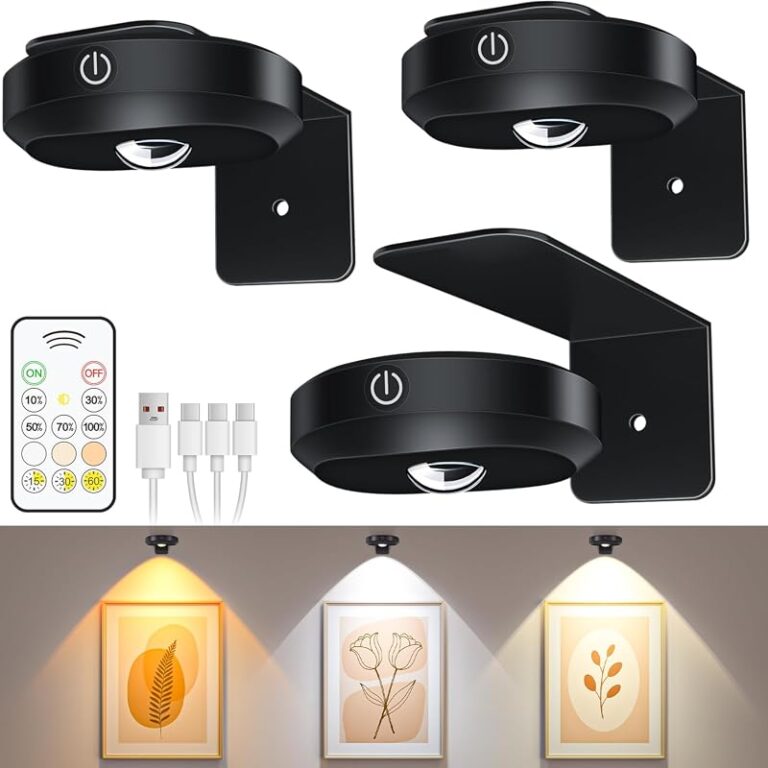
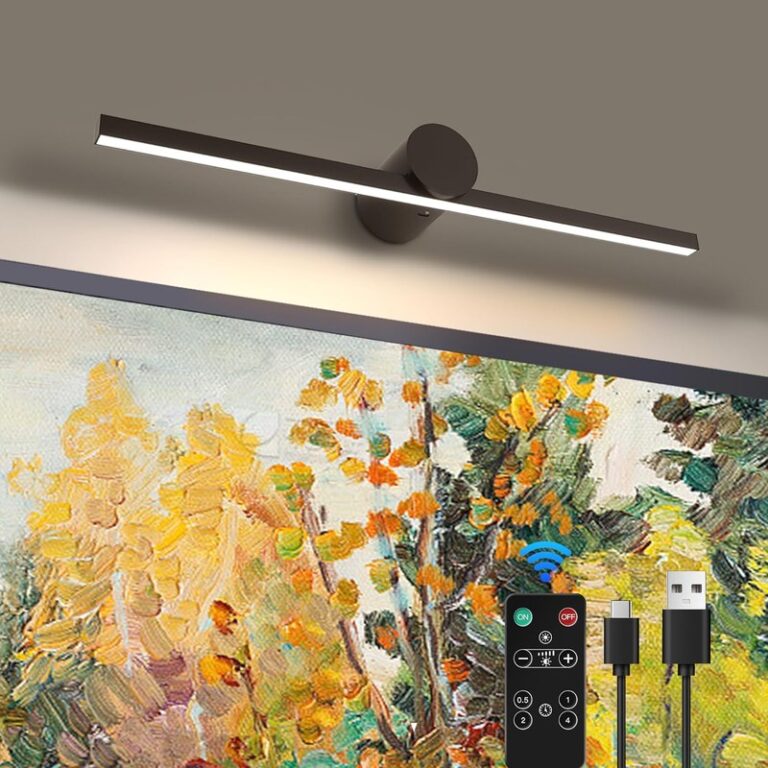
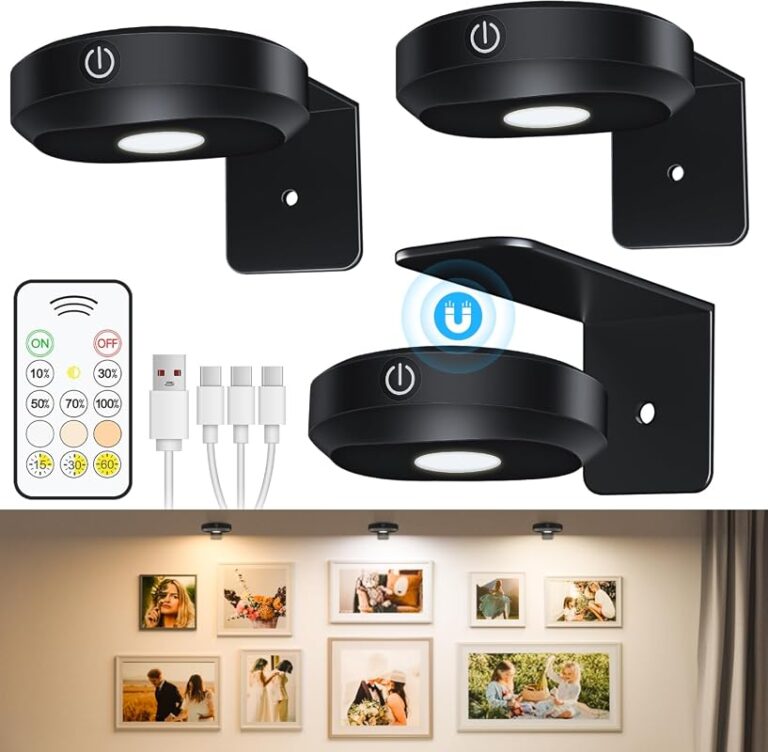
Runtime claims vary by brightness level, so check whether quoted hours are based on the highest or lowest setting. Also look at how the light charges: USB-C is often more convenient than older charging formats, and detachable light bars can be easier to recharge than fully fixed bodies.
Remote control, dimming, memory presets, and timer functions are genuinely useful rather than gimmicky. They help preserve battery life and make the light feel integrated into everyday life.
Size, finish, and materials to match frames, walls, and existing decor
A battery picture light should relate to the frame and room, not just the art. Brass and antique brass often suit traditional, vintage, and warm-toned interiors. Matte black works well with modern frames, monochrome photography, and contemporary rooms. Bronze can bridge classic and rustic spaces nicely.
Also check whether the material is solid metal, plated metal, or a painted finish over a lighter base. Product pages are the best place to confirm this. Finish quality affects not only appearance but whether the light reads as permanent decor or temporary add-on.
- Confirm the light’s recommended artwork width, not just fixture width.
- Check color temperature and whether CRI is listed.
- Look at battery type, charging method, and runtime at different brightness levels.
- Match the finish to the frame, hardware, and room lighting.
- Verify mounting method, included hardware, and wall compatibility.
Placement, Sizing, and Safe Installation for Picture Lights
Even a good fixture can disappoint if it is too small, mounted too high, or pointed poorly. Placement is what makes battery picture lights look intentional.
How wide the light should be compared with the frame
As a general styling rule, the fixture should usually be narrower than the frame but still visually substantial enough to balance it. Many decorators prefer a light that spans roughly half to two-thirds of the frame width, though the right proportion depends on the beam spread and the style of the fixture.
A very tiny light over a broad frame tends to look under-scaled, while an overly wide light can dominate the artwork. Slim contemporary fixtures can sometimes be slightly wider without looking heavy, but traditional shades usually look better when kept more restrained.
How high above the artwork to place it for even illumination
Mounting height affects both glare and coverage. Too close, and the top of the artwork can become overly bright. Too high, and the beam may spill onto the wall instead of the art.
Most picture lights look best when placed a short distance above the frame, but the exact measurement varies by fixture head, beam angle, and artwork size. It is wise to test the light position with painter’s tape or temporary holding methods before final fixing if the manufacturer allows for that planning process.
If the art has glass or acrylic glazing, check the light from both standing and seated positions before fixing it permanently. Reflections can look very different once the room lamps are on at night.
Spacing within gallery walls and how wall type affects fixing choices
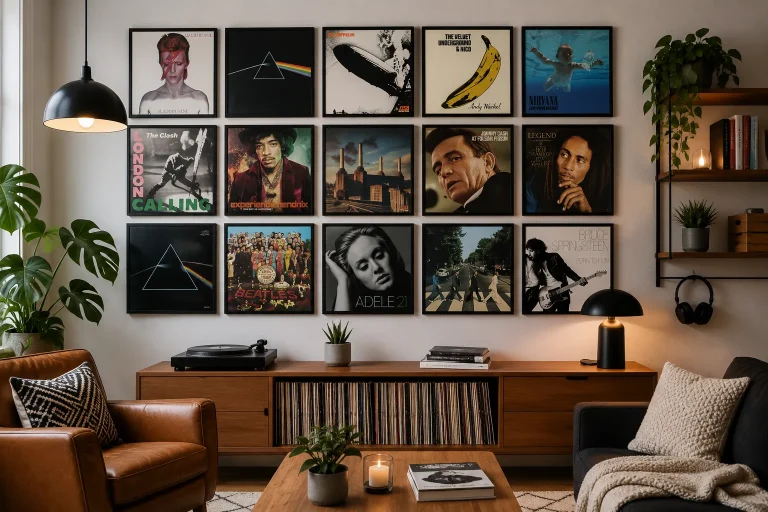
Within a gallery wall, a picture light usually works best over the anchor piece rather than trying to top every frame. One light can create a focal point and keep the arrangement from feeling cluttered. If you are building around shelves instead of direct wall hanging, our guides to are picture ledges still in style and picture ledge layout ideas can help you think through layered displays that suit battery lighting well.
Wall type matters for installation. Drywall, plaster, masonry, and paneling all require different fixing approaches, and not every mounting kit works equally well across surfaces. Follow the manufacturer’s instructions, check weight limits, and use a qualified installer if the wall is fragile, uneven, or historically sensitive.
Safety basics for batteries, heat, and secure mounting hardware
Battery picture lights are generally low-heat compared with older lighting types, but they still need safe handling. Use the recommended battery type only, avoid mixing old and new batteries, and keep charging cables and battery packs in good condition.
Mounting security is just as important as electrical safety. The fixture should be firmly fixed according to the wall type and the product’s hardware guidance. If the art itself is valuable, glazed, or placed above furniture where a falling fixture could cause damage, err on the side of professional installation.
Do not rely on unsuitable adhesive methods for heavier picture lights unless the manufacturer explicitly allows it. Always confirm wall condition, hardware limits, and whether the fixture must be removed regularly for charging.
Benefits That Make Battery Operated Picture Lights Worth Considering
The appeal of battery picture lights is not only convenience. When chosen carefully, they can improve the way art is seen and the way a room feels.
No hardwiring, cleaner styling flexibility, and easier seasonal updates
The biggest benefit is freedom from wiring. You can place art where it looks best rather than where a cord can be hidden or an electrician can easily reach. That flexibility is especially useful in layered interiors, older homes, and rooms that are still evolving.
They also suit seasonal styling. If you rotate prints, family photos, or framed textiles throughout the year, a battery light is easier to move than a wired fixture. That makes it practical for people who enjoy refreshing shelves, mantels, or small feature walls.
Useful features such as dimming, presets, and automatic shut-off
Dimming helps the light adapt to different rooms and artwork types. A soft wash may be enough for a watercolor in a bedroom, while a slightly brighter setting may suit a dark-toned print in a hallway. Presets and memory functions save time if you use the light regularly.
Automatic shut-off is one of the most valuable features because it reduces battery drain and removes the annoyance of forgetting to switch the light off. In many homes, that feature alone can make a cordless fixture feel much more practical.
Why they can be a smart option for styling smaller artworks and shelves
Battery picture lights often shine brightest—visually and practically—when used on smaller pieces. A modest framed print, portrait, or shelf-styled artwork can look elevated quickly without requiring a large fixture or complex planning.
They can also add polish to shelves and ledges, where a hardwired solution would be excessive. Small-scale art lighting works particularly well with stacked books, ceramics, and layered frames because it creates focus without adding floor or table clutter.
The Limitations: Where Battery Operated Picture Lights Can Disappoint
Battery operated picture lights are not universally impressive. Their drawbacks become more obvious when expectations are too high or the room demands more performance than the fixture can give.
Brightness trade-offs compared with mains-powered options
Even strong cordless models often have limits compared with mains-powered fixtures. If you want a dramatic wash over a large canvas or need the art to read clearly from across a large room, battery output may feel underwhelming.
This does not mean the light is poor quality. It simply means battery-powered accent lighting is usually best judged as accent lighting, not as a replacement for every wired solution.
Battery maintenance, charging routines, and long-term convenience
The convenience of no wiring can turn into mild inconvenience later if the charging routine becomes annoying. A high-mounted fixture that needs frequent removal is less appealing than one with a longer runtime or easier charging access.
Before buying, think honestly about your habits. If you dislike charging household devices or know the light will be used nightly, a plug-in or wired option may be more satisfying in the long run.
Common performance issues such as glare, uneven coverage, and colour shift
Not every disappointment is about brightness. Some models create glare on glass, throw a narrow beam with bright center spots, or produce color that feels too cool, too yellow, or simply flat. These issues are often more noticeable in person than they appear in listing images.
That is why it is worth checking official specifications, return policies, finish details, and customer photos where available. Confirming those basics can help you avoid a light that looks stylish online but performs poorly over actual artwork.
Styling Ideas: How to Make Battery Picture Lights Look Intentional, Not Temporary
The difference between “smart styling choice” and “quick fix” usually comes down to proportion, finish, and how the light relates to the rest of the room.
Matching finishes with brass, black, bronze, and contemporary frame styles
For traditional rooms, brass and antique brass usually feel the most natural, especially with warm woods, vintage frames, and classic portraiture. Matte black suits modern interiors, graphic prints, and slimmer frame profiles. Bronze often works well in transitional spaces where you want warmth without high shine.
If your frames already have visible hardware tones, echoing those finishes can make the picture light feel more integrated. The goal is not perfect matching, but visual harmony.
Using them with single statement pieces, layered shelves, and gallery walls
A single statement piece is often the easiest place to use a battery picture light well. One fixture, one focal point, and enough surrounding wall space usually creates the cleanest result. On layered shelves, choose a compact light that does not overwhelm the arrangement.
Gallery walls are trickier. Usually, one or two lights over the dominant works looks more refined than trying to illuminate every frame individually. That keeps the display from feeling busy and avoids a dotted line of tiny fixtures.
- Repeat the fixture finish elsewhere in the room through lamp bases, frame edges, or cabinet hardware.
- Use battery picture lights to emphasize the visual anchor of a wall, not every object on it.
- Keep the surrounding decor simple if the fixture has a more traditional or decorative arm profile.
- For shelves, pair the light with one standout frame and lower-height objects nearby to avoid visual crowding.
Balancing picture lighting with ambient room lighting for a polished result
Picture lights rarely look their best in isolation. They work best as part of layered room lighting that includes ambient overhead light, lamps, or sconces. When the room is too dark overall, the picture light can look harsh; when the room is too bright, it can disappear.
A dimmed, warm room with one or two softly lit artworks often feels more sophisticated than a bright room with a harsh spotlight effect. Balance is what makes the result feel intentional.
Value for Money, Common Buying Mistakes, and the Final Recommendation
Value in a battery picture light is not just about the upfront price. It is about whether the fixture suits the art, looks right in the room, and remains convenient enough to use regularly.
How to judge value beyond the purchase price
A cheaper light that needs frequent battery changes, looks obviously undersized, or casts poor color is not necessarily good value. A more thoughtfully designed model with better beam spread, dimming, and easier charging may prove more worthwhile over time.
Look at the complete package: finish quality, battery setup, controls, mounting method, and manufacturer support. Always confirm current specifications, included accessories, and warranty terms on the official listing before ordering, since these details can vary by seller and model revision.
Mistakes to avoid when choosing size, brightness, and placement
The most common mistake is buying too small. A fixture that looks elegant in a product photo may disappear over your frame. The next mistake is assuming “bright” equals “better,” when a harsh narrow beam can be less attractive than a softer, wider wash.
Placement errors are common too. Mounting the light too high, failing to account for glass reflection, or choosing a finish that clashes with the frame can make the setup look improvised rather than refined.
- Measure the artwork and compare it with the light’s recommended coverage.
- Check the room’s existing lighting before deciding how bright the picture light needs to be.
- Choose a finish that connects with the frame or nearby hardware.
- Verify battery access and charging convenience before buying.
- Choosing solely by style photo without checking beam spread.
- Assuming one small fixture will evenly light a very large piece.
- Ignoring glare risks on glass or acrylic-covered art.
- Using unsuitable fixings for delicate or heavy wall conditions.
A transparent verdict on whether battery operated picture lights are any good
Battery operated picture lights are good when your priorities are flexibility, easier installation, and attractive accent lighting for small to medium artworks. They are less convincing when you need powerful, all-evening illumination over large pieces or want a fully permanent architectural solution.
For most decor-focused homes, the best cordless picture lights are worth considering because they can add warmth, focus, and a more finished look without rewiring the room. Just buy with realistic expectations: prioritize beam spread, color quality, charging convenience, and proper sizing, and you are far more likely to be pleased with the result.
Frequently Asked Questions