How to Choose Brushes for Acrylic Painting: A Beginner-Friendly Guide

To choose brushes for acrylic painting, start with synthetic bristles, a mix of flat, round, filbert, and detail brushes, and medium-stiff brush heads that can handle thick acrylic paint. Beginners usually need 5 to 8 brushes: one large flat, one medium flat, one filbert, one round, one detail liner, and one soft blending brush.
Choosing the right acrylic painting brushes is mostly about shape, bristle type, size, and how you like to paint. Synthetic brushes are usually the best starting point because they are durable, affordable, and strong enough for acrylic paint.
I’m Julian Mercer, and I think a good brush can make painting feel calmer, easier, and more natural. A poor brush fights you. A good brush helps your hand do what your eye wants.
If you are new to acrylic painting, brush shopping can feel confusing. There are flats, rounds, filberts, fans, liners, natural hair, synthetic hair, long handles, short handles, soft bristles, stiff bristles, and endless set sizes.
The good news is simple: you do not need every brush. You need the right few. This guide will help you choose brushes for acrylic painting without wasting money on tools you will not use.
Why Brush Choice Matters in Acrylic Painting
Acrylic paint dries fast. It can be thin like watercolor or thick like soft butter. That means your brush must handle many jobs.
The right brush lets you control edges, build texture, blend color, and add details. The wrong brush can leave scratchy marks, lose bristles, or feel too floppy for thicker paint.
Brush choice also affects your style. A flat brush gives clean blocks and strong edges. A filbert gives softer shapes. A round brush gives controlled lines. A liner gives tiny details.
If you are building a creative home studio, our Creative Living section has more ideas for practical and beautiful art spaces.
Acrylic paint dries by water evaporation and forms a flexible film. That is why cleaning brushes quickly matters so much. Once acrylic dries in the bristles, it becomes much harder to remove.
How to Choose Brushes for Acrylic Painting Step by Step
Synthetic brushes are strong, affordable, and easy to clean. They work well with acrylic paint because they hold their shape and resist damage better than many soft natural hair brushes.
Buy a flat brush, round brush, filbert brush, and detail brush before adding specialty brushes. These shapes cover most painting techniques.
Choose one large brush for backgrounds, one medium brush for main shapes, and one small brush for detail. You do not need every size in a set.
Use firmer brushes for thick acrylic paint and softer brushes for blending, glazing, and smooth layers.
A good brush should feel balanced in your hand. The metal ferrule should be tight, with no wobbling or loose bristles.
The Best Brush Shapes for Acrylic Painting
Brush shape is the easiest way to understand what a brush can do. You can paint almost anything with a small group of shapes.
| Brush Shape | Best For | Why It Helps |
|---|---|---|
| Flat brush | Backgrounds, blocks, sharp edges | Covers space fast and makes clean lines |
| Round brush | Lines, curves, small shapes | Good control and flexible marks |
| Filbert brush | Petals, portraits, soft edges | Rounded tip blends shape and control |
| Detail brush | Tiny marks, highlights, fine lines | Helps with small controlled details |
| Fan brush | Texture, grass, clouds, blending | Creates repeated soft marks quickly |
| Angle brush | Edges, lettering, corners | Useful for controlled angled strokes |
Flat Brushes
A flat brush has a square end. It is one of the most useful acrylic brushes you can own.
Use it for painting backgrounds, geometric shapes, window edges, walls, skies, and strong color blocks. Turn it on its side and it can also make thin lines.
Round Brushes
A round brush has a pointed or rounded tip. It is good for drawing with paint.
Use it for curves, leaves, stems, outlines, small figures, and expressive marks. A medium round brush is very useful for beginners.
Filbert Brushes
A filbert brush looks like a flat brush with a rounded end. It is one of my favorite shapes for acrylic painting.
It creates soft edges without losing control. It is excellent for flowers, portraits, clouds, fabric folds, and organic shapes.
Detail and Liner Brushes
Detail brushes are small. Liner brushes are long and thin. Both help with final marks.
Use them for eyelashes, branches, lettering, tiny highlights, whiskers, signatures, and fine outlines.
For most beginners, I would choose a starter set with synthetic flat, round, filbert, and detail brushes. Add a fan brush later only if you enjoy texture, landscapes, or soft blending.
Synthetic vs Natural Brushes for Acrylic Paint
For acrylic painting, synthetic brushes are usually the better choice. Acrylic paint can be tough on delicate natural hair brushes, especially when it dries near the ferrule.
Synthetic brushes are often made from nylon, polyester, or Taklon. They hold shape well, clean more easily, and come in many stiffness levels.
- Best for most acrylic painters
- Durable and affordable
- Good spring and shape retention
- Easier to clean
- Available in soft and stiff options
- Better for some oils and watercolor
- Can be too soft for thick acrylics
- Often more expensive
- Can be damaged by dried acrylic paint
- Needs more careful maintenance
Which Brush Size Should You Buy?
Brush size depends on your canvas size and painting style. A tiny brush on a large canvas will make painting slow. A huge brush on a small canvas will feel hard to control.
I suggest choosing brushes by job, not by number. Brush numbers are not always consistent across brands.
| Painting Job | Recommended Brush | Good Beginner Size |
|---|---|---|
| Large background | Flat or wash brush | 1 inch to 2 inch |
| Main shapes | Flat or filbert | Size 6 to 10 |
| Soft blending | Soft filbert or mop-style synthetic | Size 8 to 12 |
| Line work | Round brush | Size 2 to 6 |
| Fine details | Detail or liner brush | Size 0 to 2 |
| Texture | Fan or stiff bristle brush | Small to medium |
Brush sizes vary by brand. A size 6 from one brand may not match a size 6 from another. Look at the brush width and shape, not just the number printed on the handle.
Why Bristle Stiffness Matters
Acrylic paint can be used thick or thin. That means stiffness matters.
Stiff brushes push heavy paint and create texture. Soft brushes glide better and help with smooth layers. Medium-stiff brushes are the safest starting point.
Choose Stiffer Brushes If You Want:
- Visible brush marks
- Texture and impasto effects
- Bold shapes
- Palette-knife style movement
- Thick paint application
Choose Softer Brushes If You Want:
- Smooth blending
- Soft skies
- Thin acrylic washes
- Glazes and transparent layers
- Gentle portrait or floral work
Best Brush Types by Painting Style
Your subject matters too. A landscape painter and an abstract painter may need different brushes.
| Painting Style | Best Brush Types | Useful Tip |
|---|---|---|
| Landscapes | Flat, filbert, fan, liner | Use fan brushes lightly for grass and trees |
| Abstract art | Large flat, stiff bristle, angle brush | Choose bold brushes that hold more paint |
| Florals | Filbert, round, detail brush | Filberts make soft petal shapes |
| Portraits | Soft filbert, round, detail brush | Use softer brushes for skin blending |
| Lettering | Angle brush, liner, small round | Practice pressure control before lettering |
| Home decor painting | Flat, foam brush, angle brush | Use wider brushes for furniture and craft surfaces |
Do’s and Don’ts When Buying Acrylic Brushes
- Do start with synthetic brushes.
- Do buy a few useful shapes instead of a huge cheap set.
- Do check that the ferrule feels secure.
- Do choose medium-stiff brushes for your first set.
- Do clean brushes before acrylic paint dries.
- Don’t buy only tiny detail brushes.
- Don’t leave brushes standing bristle-down in water.
- Don’t let paint dry near the ferrule.
- Don’t assume expensive always means better for beginners.
- Don’t use your best painting brushes for glue or varnish.
Style Guide: Build a Beautiful Acrylic Painting Kit
Acrylic painting tools can be practical and beautiful at the same time. A tidy creative corner makes it easier to sit down and paint.
If you love artful interiors as much as the painting process, our Art & Frames guide can help you think about how your finished work might be framed or displayed.
Budget Estimate for Acrylic Brushes
Common Mistakes Beginners Make
Buying Too Many Brushes
A huge set can look exciting, but many brushes may go unused. It is better to buy fewer brushes and learn how each shape behaves.
Using Brushes That Are Too Small
Beginners often choose tiny brushes because they want control. But small brushes make backgrounds and large shapes slow and streaky.
Letting Acrylic Paint Dry in the Bristles
This is the fastest way to ruin a brush. Acrylic paint dries quickly and can harden inside the bristles. Rinse often while painting.
Ignoring the Ferrule
The ferrule is the metal part holding the bristles. If paint dries there, the bristles can spread and lose shape.
Using One Brush for Everything
One brush cannot do every job well. Use large brushes for large areas and smaller brushes for details.
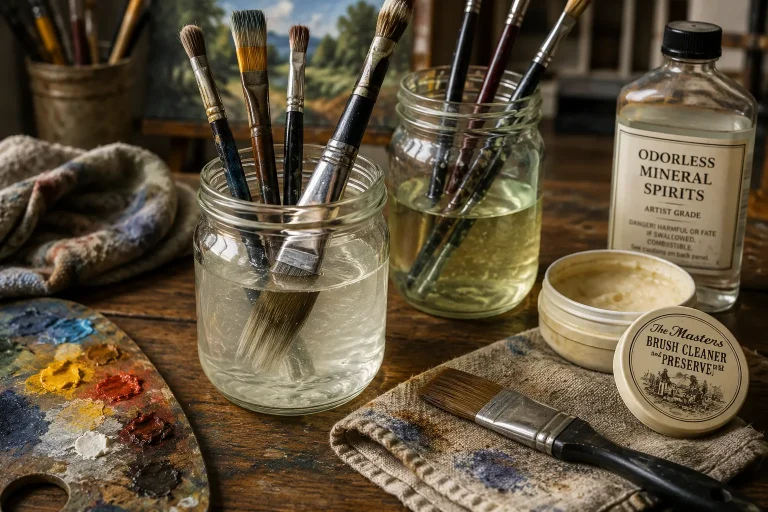
Never leave acrylic brushes soaking bristle-down in water. The bristles can bend, the handle can swell, and the ferrule can loosen. Rinse, reshape, and dry brushes flat or upright with bristles facing up.
How to Care for Acrylic Painting Brushes
Good care makes even budget brushes last longer. The main rule is simple: clean before the paint dries.
Swish the brush in water whenever you pause or switch colors. Do not let paint sit near the ferrule.
Use a soft rag or paper towel to remove extra paint and water. Pull in the direction of the bristles.
At the end of your session, clean the bristles with mild brush soap or gentle hand soap.
Shape the bristles with your fingers, then dry brushes flat or upright with the bristles up.
For more general art handling and material inspiration, I like browsing resources from MoMA and The Met Museum. For home studio styling, Apartment Therapy often has useful small-space ideas.
Shop This Look
Before You Buy: Checklist
- Does the set include flat, round, filbert, and detail brushes?
- Are the bristles synthetic and suitable for acrylic paint?
- Do the bristles spring back after bending gently?
- Is the ferrule tight and secure?
- Are there enough medium sizes, not just tiny detail brushes?
- Does the handle feel comfortable in your hand?
- Is the set affordable enough for practice?
If you are buying brushes as a gift, pair them with a sketchbook or art book from our Books & Gifts section. For more creative present ideas, explore our gift guide for art lovers.
Quick Recap
- Start with synthetic brushes for acrylic painting.
- Choose flat, round, filbert, and detail brushes first.
- Use larger brushes for backgrounds and small brushes for details.
- Pick medium-stiff bristles for the most flexibility.
- Clean brushes before acrylic paint dries.
- Buy fewer better brushes instead of a huge low-quality set.
To choose brushes for acrylic painting, focus on synthetic bristles, useful shapes, and practical sizes. A small set of good flat, round, filbert, and detail brushes will help you paint backgrounds, shapes, edges, and fine marks without feeling overwhelmed.
Frequently Asked Questions
Synthetic brushes are usually best for acrylic painting. They are durable, affordable, easy to clean, and strong enough for thick acrylic paint.
Beginners should start with a flat brush, round brush, filbert brush, detail brush, and one larger wash brush for backgrounds.
Natural hair brushes can work, but they are often too soft or delicate for acrylic paint. Synthetic brushes are usually a better and safer choice.
Use a large flat brush for backgrounds, medium brushes for main shapes, and small round or detail brushes for fine marks and finishing touches.
Most beginners only need 5 to 8 brushes. A small balanced set is usually better than a large set with many unused brushes.
You can use some watercolor brushes for thin acrylic washes, but soft watercolor brushes may not handle thick acrylic paint well.
Rinse brushes often while painting, clean them before paint dries, avoid soaking them bristle-down, and reshape the bristles after washing.
Conclusion
Learning how to choose brushes for acrylic painting does not need to be complicated. Start simple. Choose synthetic brushes, buy useful shapes, and match brush size to your canvas and painting style.
If you are just beginning, I recommend a small synthetic set with flat, round, filbert, detail, and wash brushes. Add specialty brushes later when you understand what kind of marks you enjoy making.
Most of all, take care of your brushes. Acrylic paint is forgiving on canvas, but not always forgiving on bristles. Rinse often, clean well, and your brushes will serve you through many creative sessions.