Should Gallery Picture Lights Be Dimmable

Yes, gallery picture lights should usually be dimmable because adjustable brightness helps reduce glare and suit changing room light. Fixed-output lights can still work for small, matte artwork in stable lighting.
Should gallery picture lights be dimmable? In most homes, yes—especially if you want better control over glare, evening ambiance, and how artwork looks across different times of day. A dimmable model is usually the more flexible choice, but a fixed-output light can still work well for smaller pieces, low-glare finishes, or rooms with stable lighting.
Picture lighting is one of those details that can quietly elevate a room or, if chosen poorly, make art look washed out, overly shiny, or harsher than intended. The best choice depends on the artwork itself, the frame and glazing, the room’s natural light, and whether you want the fixture to act like a subtle accent or a more noticeable design feature.
- Best overall choice: Dimmable lights offer more control in most homes.
- Glare matters: Dimming is especially helpful for glass-fronted or glossy artwork.
- Buy carefully: Check brightness, beam spread, color temperature, and compatibility.
- Placement counts: Even a dimmable light needs correct sizing and mounting height.
- Not always necessary: Fixed-output can suit smaller matte pieces in predictable light.
Should gallery picture lights be dimmable? The short answer for most homes
For most people, dimmability is less about luxury and more about control. Art rarely looks identical in bright afternoon light, under warm evening lamps, and in a darker hallway at night. A dimmable picture light lets you adapt to those shifts instead of living with one output level that may only look right at one time of day.
When dimming improves art viewing
Dimming helps most when your artwork sits behind glass, has a glossy surface, or hangs in a multipurpose room where lighting changes often. It is also useful if the piece is large, richly colored, or heavily textured, because too much brightness can flatten details while too little can make the work disappear into the wall.
If you entertain in the evening, a dimmable light can make art feel integrated into the room rather than spotlit too aggressively. That matters in living rooms and dining rooms, where the goal is often a layered, comfortable glow rather than museum-level intensity.
When a fixed-output picture light may be enough
A non-dimmable picture light can still be perfectly reasonable if the artwork is modest in size, the finish is matte, and the room has fairly predictable lighting. It can also suit spaces where the picture light is mostly decorative and the art does not need fine-tuned illumination.
Fixed-output models may feel simpler to buy and use, with fewer compatibility questions. If you already know the brightness is appropriate for your frame size and wall color, and you do not expect to change the room’s lighting mood often, dimming may be optional rather than essential.
Why dimmability matters for artwork, mood, and visual comfort
The biggest advantage of a dimmable picture light is that it gives you a way to fine-tune how the art is seen without changing the artwork itself. That affects not only visibility, but also comfort, atmosphere, and the way the wall relates to the rest of the room.
Reducing glare on glass, varnish, and glossy finishes
Glare is one of the most common reasons people regret a picture light choice. Even a beautifully made fixture can create distracting reflections if the output is too strong for the frame’s glazing, the wall height, or the finish of the artwork.
Dimming will not solve every glare problem—placement still matters—but it can soften harsh reflections enough to make the piece easier to enjoy. This is especially relevant for framed photography, prints under glass, and paintings with varnished surfaces.
If light exposure is part of your concern, it is also worth reading our guide on do LED lights fade pictures, since bulb type and intensity both matter when illuminating art over time.
Balancing the picture light with daylight and ambient room lighting
A picture light does not exist in isolation. During the day, sunlight and ambient room lighting may already illuminate the piece well enough. At night, that same fixture may suddenly feel too bright unless it can be lowered.
Dimmability helps the picture light work with table lamps, sconces, recessed lighting, and daylight instead of competing with them. In practical terms, that means the art can stay visible without becoming the brightest object in the room unless you want it to be.
Creating a more considered gallery effect in the evening
In the evening, slightly lowered light levels often make art feel more intentional and refined. Instead of blasting the frame with light, a dimmed picture light can create gentle emphasis, helping the artwork read as part of a composed interior.
Use dimmable picture lights to create a layered evening look: soft ambient lamps in the room, with artwork illuminated just enough to draw the eye without overpowering nearby furniture or wall color.
What to look for in a dimmable gallery picture light before you buy
Not every dimmable model performs the same way. Some offer smooth adjustment and reliable color quality, while others simply add a brightness button without much finesse. Before buying, focus on the specifications and design details that actually affect the art.
Brightness output and beam spread for different artwork sizes
Brightness needs vary by artwork size, wall color, and viewing distance. A small framed print may only need modest output, while a wide painting or oversized photograph often needs a longer fixture and broader beam spread to avoid bright centers and dark edges.
Check the manufacturer’s stated coverage guidance if available, but treat it as a starting point rather than a guarantee. A bright light over a dark wall may read differently than the same fixture over a pale wall, and reflective glazing changes the result again.
Colour temperature and colour rendering for accurate tones
Color temperature shapes how warm or cool the artwork appears. Many buyers prefer a warm white to soft neutral white look for residential spaces, but the right choice depends on the art and the room. Very warm light can mute crisp whites and cool blues, while very cool light can make traditional interiors feel stark.
Color rendering matters too. A fixture with better color quality will generally show reds, greens, skin tones, and subtle neutrals more faithfully. If the manufacturer provides color rendering information, it is worth checking alongside brightness and dimming details.
Power source options: hardwired, plug-in, rechargeable, or battery
Hardwired picture lights often look the most integrated, but they usually require more planning. Plug-in options can be easier to install, especially if you want flexibility without opening walls. Rechargeable and battery-powered models appeal to renters and anyone avoiding electrical work.
Each power source comes with trade-offs. Rechargeable and battery-operated options reduce installation hassle, but they may involve charging or battery replacement routines. If that route interests you, our guides to are battery operated picture lights any good and do battery picture lights need to be charged can help clarify the everyday maintenance side.
Dimmer compatibility, controls, and memory settings
This is where many buying mistakes happen. Some lights dim from a built-in switch, some use a remote, some pair with touch controls, and some only work properly with certain wall dimmers. A fixture described as dimmable is not automatically compatible with every dimming setup.
Memory settings can also be useful. If a light returns to your preferred brightness level after being switched off, it feels much more seamless in daily use. Always confirm control method, dimming range, and compatibility on the official product listing before buying.
Materials, finish quality, and how the fitting complements the frame
A picture light is both a lighting tool and a visible decorative fitting. Brass, bronze, black, chrome, and painted finishes all change the look. The best choice usually echoes either the frame, nearby hardware, or another metal finish already present in the room.
Finish quality matters because the light sits close to eye level and close to the artwork. A poorly chosen finish can distract from the piece, while a well-matched one can make the entire display feel custom.
- Confirm the fixture width suits the artwork, not just the wall.
- Check brightness, beam spread, and whether the light is truly dimmable.
- Verify color temperature and any available color rendering details.
- Match the power source to your room and installation limits.
- Review official compatibility, care, and warranty information before ordering.
Placement, sizing, and spacing: how to get the light right over art
Even the best dimmable fixture can disappoint if it is the wrong size or mounted poorly. Placement affects coverage, glare, and whether the light feels tailored to the piece.
Choosing the right fixture width for small, medium, and oversized pieces
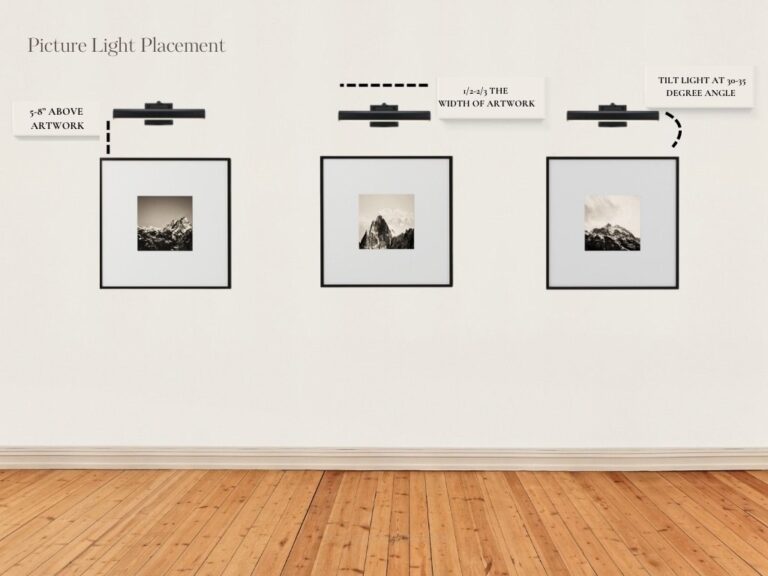
As a rule, the light should feel proportionate to the artwork rather than span its full width edge to edge. Small pieces often look best with a compact fitting that does not visually overpower the frame. Medium pieces can handle a more substantial fixture, while oversized works often need a longer bar or a model specifically designed for wider coverage.
If the fixture is too short, the center of the artwork may be bright while the outer edges fall away. If it is too large, the fitting can dominate the composition and make the frame look secondary.
How high above the frame to mount a picture light
The ideal mounting height varies by fixture design, beam angle, and frame depth. In general, the light should sit high enough to spread evenly over the artwork but not so high that it loses focus or throws glare into the room.
Manufacturer guidance is the best reference here, especially for integrated LED models with a fixed beam pattern. If you are unsure, it is wise to confirm placement before drilling or to consult a professional installer for hardwired fittings.
Single artworks versus multi-piece gallery walls
A single statement piece is usually the easiest scenario for a picture light. Gallery walls are more complex. One light rarely distributes perfectly across multiple frames unless the arrangement is compact and designed for that effect.
For multi-piece displays, you may be better off using room lighting, multiple small fixtures, or a picture ledge approach rather than trying to force one picture light to do everything. If you display art on shelving instead of direct wall mounting, our article on how deep a picture ledge should be for framed art may help with planning.
Wall type, fixing hardware, and basic electrical safety considerations
Wall material affects what mounting method is appropriate. Drywall, plaster, masonry, and paneling all require different considerations, and the hardware included with a light may not be right for every wall type or every artwork arrangement.
Do not guess on wall anchors, weight limits, or electrical connections. Check the wall type, the fixture’s installation requirements, and use a qualified installer when hardwiring or when the wall condition is uncertain.
This is especially important for heavier metal fixtures, older walls, or installations above valuable framed pieces.
Which rooms benefit most from dimmable picture lights?
Dimmable picture lights are not equally useful in every room. Their value increases in spaces where the mood changes throughout the day or where the artwork plays a strong decorative role.
Living rooms, dining rooms, and hallways
These are often the best rooms for dimmable picture lights. Living rooms and dining rooms shift from brighter daytime use to softer evening use, so adjustable output makes sense. Hallways also benefit because they can feel dramatic at night with low-level art lighting, yet too intense if the fixture is fixed at full brightness.
Bedrooms, studies, and reading corners
In bedrooms and studies, dimmability adds comfort. Artwork near a bed, desk, or reading chair should not feel glaring when the rest of the room is calm and subdued. A lower setting often feels more restful while still highlighting the piece.
These spaces also tend to reward lighting that feels intimate rather than theatrical, which makes dimming especially useful.
When kitchens, bathrooms, or humid spaces need extra caution
Kitchens and bathrooms can be trickier because humidity, heat, grease, or splashing may affect the suitability of a fixture. Not every picture light is rated or intended for these environments.
If you are considering one in a humid or high-moisture area, check the manufacturer’s location guidance carefully. Decorative appeal should never come ahead of safe placement and appropriate product use.
Styling ideas: matching a dimmable picture light to your decor and artwork
The right picture light should feel like part of the room’s visual language. That means considering style period, finish, frame material, and the character of the art itself.
Traditional, contemporary, and mixed-period interiors
Traditional rooms often suit classic forms in brass, bronze, or antique-inspired finishes. Contemporary interiors usually lean toward slimmer silhouettes, matte black, or restrained metal finishes. Mixed-period homes can go either way, but the most successful choices usually connect the light to another element in the room so it feels intentional.
Pairing finishes with frames, hardware, and wall colours
You do not need a perfect metal match, but you do want harmony. Warm metals often pair well with dark woods, traditional oil paintings, and layered interiors. Black can ground modern photography and graphic prints. Chrome or polished finishes can work in cleaner, cooler spaces, though they may draw more attention.
Using picture lights to elevate photography, paintings, and prints
Photography often benefits from careful dimming because glass and glossy papers can reflect strongly. Paintings can gain depth when the light is tuned low enough to reveal texture without flattening brushwork. Prints tend to look best when the light is even, soft, and proportionate to the frame size.
In all cases, the light should support the artwork rather than become the main attraction.
The benefits, limitations, and common mistakes to avoid
Dimmable picture lights solve real problems, but they are not automatically the right answer for every display. It helps to understand both the upside and the compromises before buying.
Where dimmable models offer better flexibility and value
If you plan to keep the artwork for years, change rooms seasonally, or update lamps and wall colors over time, dimmability adds useful flexibility. It can also protect you from buying a light that turns out slightly too bright for everyday use.
That flexibility often translates into better long-term value, especially in rooms where the art is a focal point.
Potential drawbacks: cost, charging routines, and compatibility issues
Dimmable models can cost more, and cordless versions may ask for more upkeep. Remote controls, charging schedules, batteries, and dimmer compatibility can all add friction if the product is not well matched to your space.
- Better glare control
- More adaptable to daylight and evening use
- Improved mood and styling flexibility
- Often a safer choice when brightness is hard to predict
- May cost more than fixed-output models
- Battery or rechargeable options can need ongoing upkeep
- Some products have limited dimmer compatibility
- Extra features do not fix poor sizing or placement
Mistakes with brightness, colour temperature, and placement
The most common mistake is buying based on appearance alone. A beautiful fixture can still be too bright, too cool, too narrow in beam spread, or awkwardly sized for the frame.
Another common issue is treating dimmability as a substitute for proper placement. It is a valuable feature, but it cannot fully correct a light mounted too high, too low, or too close to reflective glass.
Care, maintenance, and value: are dimmable gallery picture lights worth it in 2026?
In 2026, dimmable picture lights remain a worthwhile upgrade for many homes because they answer a practical need: art is viewed under changing conditions, and adjustable light is easier to live with than a one-level fixture. That does not mean every display needs one, but it does mean the feature is often more useful than it first appears.
Cleaning finishes, checking fittings, and preserving consistent performance
Regular care is simple but important. Dust the fixture gently, follow the finish-specific care guidance from the manufacturer, and check that screws, brackets, or charging connections remain secure over time.
Integrated LED models and battery-powered designs may also need occasional performance checks if brightness seems uneven or controls become unreliable. Always follow official care instructions rather than using abrasive cleaners or guesswork.
When to invest more for premium materials or better light quality
It can make sense to spend more when the artwork is valuable, the fixture will sit in a formal room, or finish quality is a major part of the design. Better materials, smoother dimming, and stronger color quality often show up most clearly when the light is used every evening and seen at close range.
If the display is casual or temporary, a simpler model may be enough—provided the core specifications still suit the artwork.
Final recommendation: who should choose dimmable picture lights, and who need not
Choose a dimmable picture light if your artwork sits behind glass, your room lighting changes through the day, or you want more control over mood and visual comfort. It is also the safer option when you are unsure exactly how bright the fixture will feel once installed.
You may not need dimming if the artwork is small, matte, and displayed in a room with stable lighting where the picture light is mostly decorative. For most focal-point art displays, though, dimmability is a practical feature worth prioritizing—provided you also get the size, color quality, and placement right.
- Dimmable picture lights are usually the better choice for glass-fronted art and rooms with changing light.
- Fixed-output models can still work for smaller, matte pieces in stable lighting conditions.
- Check brightness, beam spread, color temperature, power source, and dimmer compatibility before buying.
- Good placement matters just as much as dimming for reducing glare and achieving even coverage.
Frequently Asked Questions