
Do Battery Operated Picture Lights Work

Yes, battery operated picture lights work well for accent lighting, especially in rentals, hallways, bedrooms, and rooms with changing art. Their main limits are runtime and output, so they are best when convenience and a clean look matter more than maximum brightness.
Do battery operated picture lights work for real rooms and real wall art? Yes—when the light is chosen for the right frame size, brightness level, and placement, it can deliver attractive accent lighting without wiring or a nearby outlet.
- Best use: They are strongest as accent lights for framed art, not as full-room lighting.
- Key specs: Check brightness, beam spread, colour temperature, and battery type before buying.
- Placement matters: Correct height, width, and angle help avoid glare and uneven light.
- Ideal spaces: Rentals, hallways, bedrooms, dining walls, and gallery-style displays are a natural fit.
- Main tradeoff: Battery convenience comes with runtime limits and regular maintenance.
Do Battery Operated Picture Lights Work? A Clear Answer for 2026
They do, but they work best as accent lighting rather than as a full replacement for hardwired picture lights. For many homes, that is exactly the point: you get a cleaner install, more flexibility, and a simple way to highlight framed art in places where wiring would be inconvenient or impossible.
The strongest use cases are rental spaces, narrow hallways, bedrooms, and gallery walls where you want focused illumination without opening the wall or hiring an electrician. The main tradeoff is that battery power usually limits runtime and output compared with plug-in or wired options, so the best choice depends on how often you want the light on and how much brightness you expect.
How Battery Operated Picture Lights Work and Where They Fit Best
Battery operated picture lights use an internal battery pack to power LED sources, usually through a compact housing mounted above the frame. Most are designed to cast a downward wash of light across artwork, photographs, or framed prints, with the beam aimed to reduce spill onto the wall around it.
Because they are self-contained, they are useful where cord management would look messy or where drilling for wiring is not practical. They also work well for seasonal decorating, temporary displays, and spaces that change often, such as entryways or rooms with rotating art.
Typical brightness, beam spread, and colour temperature
Brightness varies widely by model, so it helps to think in terms of accent lighting rather than task lighting. A good picture light should illuminate the artwork evenly without overpowering the room or washing out the frame’s finish.
Beam spread matters just as much as brightness. A narrow beam can spotlight a small print, while a wider beam is better for larger frames or grouped artwork. If the beam is too tight, the center may look hot and the edges may fall into shadow.
Colour temperature also shapes the result. Warm white tends to flatter wood frames, vintage prints, and traditional interiors, while neutral white can suit modern art, black frames, and cleaner gallery-style walls. If you are comparing options, check the listed colour temperature and look for dimming if you want more control over the mood.
Manufacturers may describe brightness in lumens, beam angle, or simple “light levels,” and not every listing uses the same method. Compare models carefully rather than assuming two lights with similar wording will look the same on the wall.
Battery types, runtime, and charging options
Battery type is one of the biggest practical differences between models. Some use replaceable batteries, which can be convenient for quick swaps, while others use rechargeable packs that reduce ongoing battery purchases and are often easier to live with over time.
Runtime depends on battery capacity, brightness setting, and whether the light includes a timer or motion-style control. Higher output and longer daily use naturally shorten runtime, so a light that seems ideal for occasional evening display may be less appealing if you want it on every night.
Rechargeable models can be especially useful for renters and anyone who dislikes frequent battery changes, but it is still worth checking how the pack charges and whether the battery is user-replaceable. The official product listing and care instructions are the best place to verify those details before buying.
If you want the most practical battery setup, look for a model with dimming and a timer. Those two features often matter more than a slightly higher maximum brightness because they help stretch runtime while keeping the art softly lit.
What to Look for When Buying a Battery Operated Picture Light
The best battery operated picture light is not just the brightest one. It should suit the size of the frame, the style of the room, and the way you plan to maintain it over time.
Before comparing finishes or decorative details, focus on the core function: how the light will sit above the artwork, how it will be powered, and whether the mounting method matches your wall and frame setup.
Build quality, finish, and materials that suit framed art
Picture lights sit close to artwork, so their finish is part of the display. Brushed metals, matte black, antique brass, and soft gold finishes are common because they tend to read as intentional rather than distracting.
Build quality matters because the fixture may be adjusted, removed for charging, or handled more often than a hardwired light. Look for a stable arm, a secure battery compartment, and a finish that matches the tone of the frame rather than competing with it.
For more delicate or formal framing, a slimmer profile often looks better than a bulky housing. If the artwork itself is important, the light should feel like a supporting element, not the visual centerpiece. For related framing choices, our guide to large wooden picture frames can help you think through how finish and scale work together.
Light output, dimming, and remote or smart controls
Dimming is one of the most useful features in a battery light because it lets you tune the display to the room. A lower setting may be enough for evening ambiance, while a brighter setting can help a piece stand out in a darker hallway.
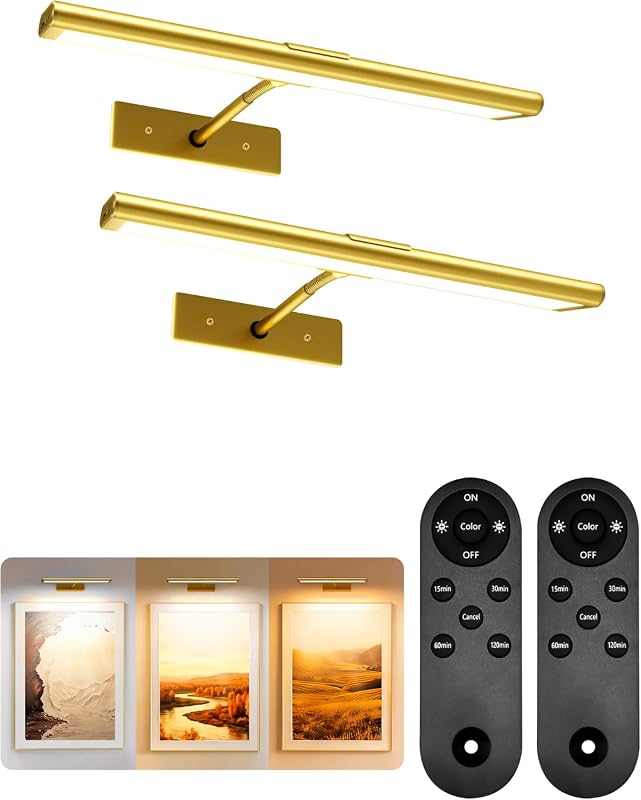
Remote controls are helpful when the light is mounted higher than arm’s reach or when you want to adjust several lights in a row. Smart controls are less common in this category, but when available they can be convenient for schedules and scene changes.
Do not assume more controls always mean better performance. Some of the most useful models are simple, well-balanced lights with good beam quality, reliable dimming, and intuitive on/off access.
Mounting style, weight, and wall compatibility
Mounting style affects both appearance and practicality. Some picture lights attach directly to the frame, while others mount to the wall above the artwork. The right choice depends on the frame, the wall surface, and how permanent you want the installation to be.
Weight is especially important for battery models because the battery pack can add bulk. Always check the manufacturer’s instructions for mounting hardware, wall type compatibility, and any weight guidance. If the light is going above a heavy framed piece or into a wall material you are unsure about, a professional installer may be the safer option.
For art display ideas that pair well with lightweight lighting, a wall of smaller frames or a shelf-based arrangement can be easier to adjust. Our article on picture frames collage wall decor offers useful layout inspiration if you are building a grouped display.
Best Rooms and Styling Uses for Battery Operated Picture Lights
These lights shine most in spaces where you want a decorative focal point without committing to wiring. They are especially helpful in rooms that are already finished, rented, or frequently rearranged.
Think of them as mood-setting accents. They can make art feel more intentional after dark, but they are most convincing when the surrounding room already has a balanced lighting plan.
Living rooms, hallways, bedrooms, and dining spaces
Living rooms are a natural fit because picture lights can help anchor a sofa wall, mantel display, or reading corner. Hallways also work well since a focused light can make a narrow passage feel more curated and less utilitarian.
Bedrooms benefit from softer output and warm colour temperatures, especially when the goal is atmosphere rather than brightness. Dining spaces can use picture lights to create a more finished, layered look, particularly above a sideboard or a framed print near the table.
A single battery picture light above one meaningful piece can feel more refined than trying to light every wall in the room.
Matching the light to frames, wall art, and gallery wall layouts
Battery picture lights look most convincing when the scale suits the art. A small light above a large frame may feel undersized, while an oversized fixture can overwhelm a restrained print or photograph.
For gallery walls, one light can sometimes serve the whole arrangement if the grouping is compact and centered. For larger or more irregular layouts, however, separate accent lighting may be more effective than trying to force one fixture to do everything.
If you are working with display pieces that lean modern or minimal, lighter visual hardware often helps. For example, a clear or understated frame can keep the focus on the art itself, which is why some readers also explore options like a clear acrylic picture frame when planning a clean wall composition.
Placement, Sizing, and Installation Guide
Placement is what separates a polished picture light from one that feels awkward. Even a good fixture can look wrong if it is too high, too low, or too narrow for the frame.
The goal is simple: place the light so it enhances the artwork evenly while staying visually aligned with the frame and the room’s proportions.
How to position the light above a frame or artwork
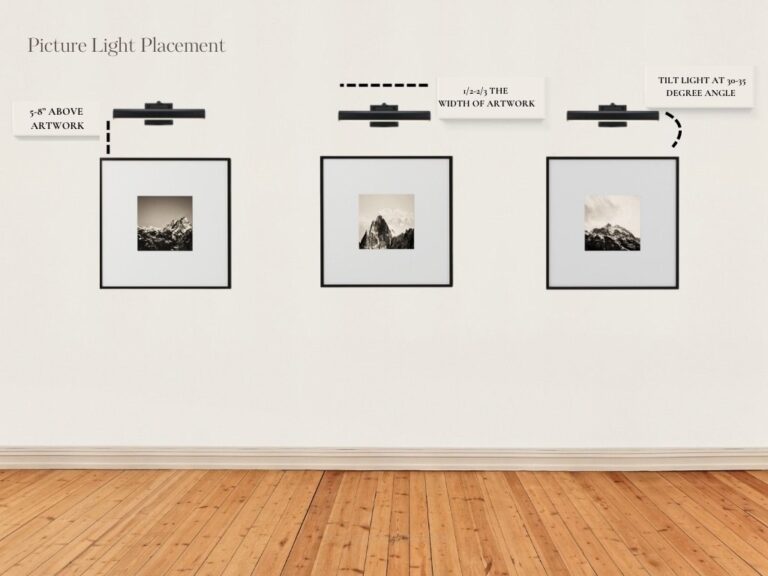
In general, the light should sit centered over the artwork and extend far enough to cover the width of the piece without spilling too much onto the wall. The exact distance depends on the fixture design, the frame size, and how the beam is shaped.
If the light is attached to the frame, make sure it does not crowd the top edge or hide part of the molding. If it is wall-mounted, align it carefully so the fixture feels intentional rather than floating off-center.
Spacing, wall type, and hanging hardware considerations
Spacing matters most when the artwork is part of a larger arrangement. Leave enough breathing room above the frame so the light can read as a separate design element, but not so much that it looks disconnected.
Wall type affects the hardware you need. Drywall, plaster, brick, and tile each require different fasteners, and not every battery picture light includes hardware that suits every surface. Check the product’s instructions before assuming a standard anchor will be enough.
Do not guess at wall anchors for heavier fixtures or valuable artwork. Confirm the wall material, the fixture weight, and the hanging hardware before installation, and consult a professional if the setup is uncertain.
How to avoid glare, shadows, and uneven illumination
Glare usually happens when the beam points too directly at the viewer or when the light sits too close to reflective glass. A slightly adjusted angle can make a big difference, especially with framed pieces under glass.
Shadows can appear if the beam is too narrow or the fixture is mounted too high. Uneven illumination is often a sizing issue: the light may simply be too short for the width of the frame or too weak for the distance it has to cover.
- Choose a beam that covers the art evenly from edge to edge.
- Test the angle before finalizing placement if the fixture allows adjustment.
- Use dimming to fine-tune the look in evening light.
- Mounting the light so high that it creates a spotlight effect.
- Using a finish or beam that reflects harshly off glass.
- Ignoring the frame width when choosing fixture size.
Benefits and Limitations of Battery Operated Picture Lights
Battery power is appealing because it removes one of the biggest barriers to art lighting: access to electricity. That convenience can make a room feel finished much faster than a wired solution.
Still, the category has real limits. The best decision comes from understanding where battery power is a feature and where it is a compromise.
When battery power is the smarter choice
Battery operated picture lights make the most sense when you need flexibility. They are a strong fit for renters, temporary installations, narrow walls, and rooms where cords would be distracting or difficult to hide.
They are also useful for art that changes often. If you rotate prints, move frames seasonally, or rearrange gallery walls, a battery light is easier to adapt than a wired fixture.
For readers comparing lighting and display choices, it can also help to understand how different light sources affect artwork over time. Our article on do LED lights fade pictures is a useful companion read when you are thinking about long-term display.
Common drawbacks: runtime, output, and maintenance
The biggest drawback is obvious: batteries need attention. Whether you are recharging or replacing them, the fixture will eventually need maintenance, and that is part of the ownership experience.
Output can also be limited compared with hardwired options. If you want strong illumination for a large statement piece or a dark room, a battery model may feel more like an accent than a primary light source.
Some models also have more visible housings because they must accommodate battery storage. That does not make them unattractive, but it does mean the design has to work a little harder to stay visually light.
- No wiring required
- Flexible for rentals and changing displays
- Clean look when cords would be distracting
- Good for soft accent lighting
- Runtime depends on battery and brightness
- Usually less powerful than wired options
- Battery changes or charging add upkeep
- Some models look bulkier than plug-in lights
Care, Maintenance, and Battery Efficiency Tips
Good care helps a battery picture light look better and work longer. Most maintenance is simple, but it is worth treating the finish and battery system with the same attention you would give any decorative fixture.
The more often a light is adjusted, charged, or cleaned, the more important it becomes to follow the manufacturer’s instructions rather than improvising.
Cleaning finishes, replacing batteries, and preserving performance
Dust the fixture gently with a soft, dry cloth. Avoid harsh cleaners unless the product instructions specifically allow them, because plated and painted finishes can be sensitive.
When replacing batteries or charging packs, make sure the compartment is closed securely before re-mounting or turning the light back on. If the light begins to dim unevenly, check the battery condition first before assuming the fixture is failing.
Keep an eye on any moving parts, especially adjustable arms or swivel heads. If they loosen over time, follow the manufacturer’s guidance for tightening rather than forcing the mechanism.
Simple habits to extend lifespan and reduce waste
Use dimming whenever the full output is not necessary. Lower brightness usually improves runtime and helps the artwork feel more elegant in the evening.
Timers are another easy way to reduce battery drain. If the light only needs to be on for a few hours after sunset, there is little reason to leave it running all night.
For readers who enjoy display pieces that are easy to move and update, flexible wall decor can be a strong match. A setup built around picture ledge layout ideas can be especially practical when you want to change art without reworking the whole wall.
- Match warm light with traditional frames and cooler light with modern prints.
- Use one picture light as a focal point instead of over-lighting every frame.
- Choose a finish that echoes the frame hardware or nearby decor accents.
- Check the beam width against the artwork before you buy, not after installation.
Final Verdict: Who Should Choose a Battery Operated Picture Light?
A battery operated picture light is best for people who want attractive art lighting without wiring, especially in rentals, hallways, bedrooms, and rooms with changing displays. It is also a smart choice when the goal is atmosphere and flexibility rather than strong, all-day illumination.
If you are lighting one favorite frame, a compact gallery wall, or a piece in a place where cords would be awkward, battery power can be the most practical solution. If you need brighter, longer-running, or more permanent lighting for a large artwork, a hardwired or plug-in option may be the better long-term fit.
Best-fit buyer profiles and room-style recommendations
This category suits renters, decorators who rearrange often, gift shoppers choosing a stylish accent, and homeowners who want a polished look without electrical work. It is especially appealing in rooms where the art is part of the mood, such as a reading nook, entry hall, or dining room side wall.
For the cleanest result, pair the light with a frame and wall arrangement that already have visual balance. If your display leans modern, a restrained finish and simple profile usually work best; if it leans classic, a warmer metal tone can feel more natural.
Transparent recommendation based on convenience, styling, and value
My practical recommendation is simple: choose battery operated picture lights when convenience and appearance matter more than maximum output. They are worth considering if you want a tidy, reversible way to elevate framed art, but they are not the best answer for every room or every artwork.
Before buying, confirm the fixture size, battery type, mounting method, and expected runtime on the official product listing. That is the most reliable way to know whether the light will suit your wall, your frame, and the amount of use you actually expect.
Frequently Asked Questions




One Comment