Large Vs Small Dimmable Picture Wall Light

Choose a large dimmable picture wall light for wide artwork, bigger walls, and a stronger decorative presence. Choose a small one for narrow frames, tighter spaces, and a subtler look.
Large vs small dimmable picture wall light decisions usually come down to proportion, brightness control, and how formal or subtle you want the finished look to feel. A larger fitting can make a single artwork or mirror feel anchored and architectural, while a smaller one often suits tighter walls, modest frames, and more understated interiors.
Choosing well is less about following a fixed size rule and more about reading the wall as a whole: the art, the frame, the ceiling height, the room mood, and the power setup all matter. If you are still narrowing down the basics, Hurrell Editions also has a clear guide on what a dimmable picture wall light is and how this category differs from standard accent lighting.
- Best starting point: Match the fitting to artwork width and wall scale, not just personal preference.
- Large works best when: The art is a focal point and the room can support more visual weight.
- Small works best when: The wall is narrow or the room needs a quieter, more refined accent.
- Technical details matter: Beam spread, dimming range, CRI, and color temperature affect results as much as size.
- Always verify: Confirm official dimensions, power source, mounting needs, and room suitability before buying.
Large vs small dimmable picture wall light: which size works best?
Neither size is automatically better. The right choice depends on whether the light should quietly support the artwork or become part of the room’s decorative structure.
How artwork size, wall width, and viewing distance change the answer
A large picture wall light generally works best when the artwork is wide, the wall has visual weight, or the viewer sees the piece from farther away. In a living room with a substantial framed print above a sideboard, for example, a larger fitting can spread light more evenly and keep the top of the composition from looking visually pinched.
A small fitting usually works better when the frame is narrow, the wall area is limited, or the artwork is viewed up close. In a bedroom nook, study, or stair landing, a compact picture light can feel more precise and less dominant.
Viewing distance matters more than many shoppers expect. If the art is mainly seen from across the room, a slightly larger light often reads as balanced. If it is examined at close range in a corridor or reading corner, a smaller light can preserve a more intimate scale.
When a large fitting creates balance and when a small fitting looks more refined
Large fittings create balance when the artwork has a thick frame, dark matting, a wide mirror surround, or enough wall presence to support a stronger horizontal line. They also help in rooms with taller ceilings, traditional millwork, or furniture beneath the art that already gives the area some visual heft.
Small fittings look more refined when the art is delicate, the frame profile is slim, or the room leans minimalist. They can also be the better answer when you want the light to disappear visually during the day and only reveal itself as a functional accent at night.
As a styling principle, large tends to feel more intentional and decorative, while small tends to feel cleaner and quieter. That is an editorial judgment rather than a universal rule, but it is a useful one when you are deciding between two proportional options.
What to look for before choosing a dimmable picture wall light
Width in relation to the frame or artwork
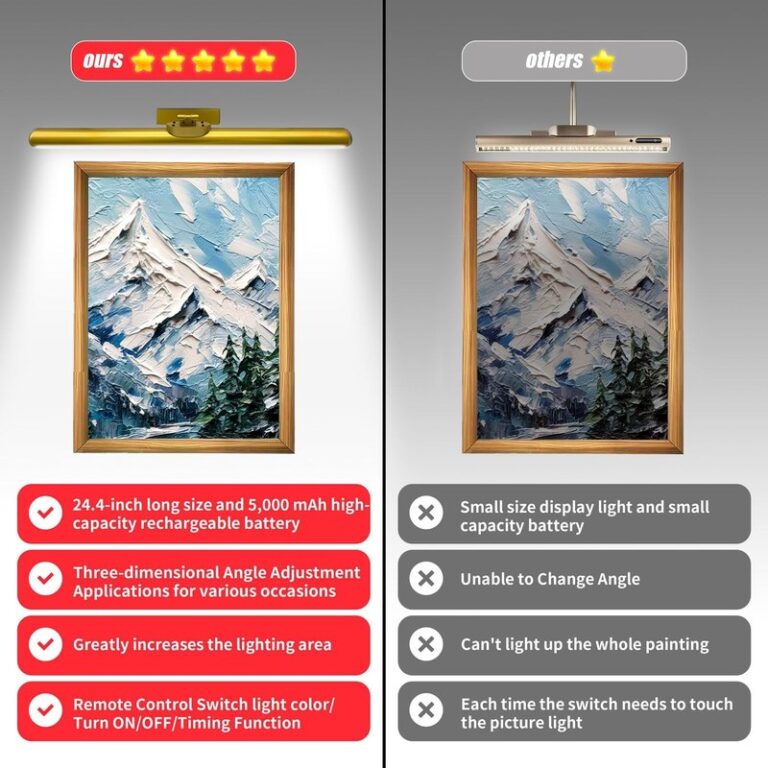
One of the most reliable checks is the width of the fitting relative to the frame. Many decorators prefer a picture light that spans a meaningful portion of the artwork width without matching it edge to edge. Exact ratios vary by model and beam design, so it is smarter to compare the manufacturer’s dimensions and coverage guidance than to rely on one rigid formula.
If the fitting is too long, it can dominate the piece and make a modest frame look undersized. If it is too short, the center may glow while the outer edges fade.
Use painter’s tape to mark the light’s width above the frame before buying or installing. That quick visual test often reveals whether a “safe” small option is actually too timid or whether a large option looks perfectly settled in the room.
Brightness, beam spread, and dimming performance
Brightness is not just about output. A strong light with poor beam spread can create hotspots, while a lower-output light with better diffusion can make art look more even and expensive.
Dimming performance matters because picture lighting is rarely used at full strength all the time. In evening settings, a good dimming range lets the artwork glow without pulling attention away from table lamps, sconces, or ceiling lights. If you want more context on why dimming is often worth prioritizing, see Hurrell Editions’ guide on whether gallery picture lights should be dimmable.
Check whether the dimming is built into the fixture, controlled by a remote, compatible with a wall dimmer, or limited to preset brightness levels. These details vary significantly by brand and power source.
Colour temperature for oil paintings, prints, photography, and mixed-media pieces
Color temperature changes how artwork feels. Warmer light can flatter traditional oils, antique-style frames, and cozy rooms. Neutral light often suits prints and mixed-media work where you want a cleaner read on tones. Photography can go either way depending on whether the image palette is warm, monochrome, or highly color-sensitive.
There is no single best setting for every artwork. What matters is avoiding a mismatch between the light and the art’s mood. A very warm lamp can muddy cool-toned photography, while an overly cool lamp can make heritage-style art feel flat or clinical.
When possible, verify the listed color temperature and CRI in the official specifications rather than assuming all integrated LEDs will look similar.
Power source options: hardwired, plug-in, and rechargeable designs
Hardwired picture lights usually give the most built-in, architectural look. Plug-in designs are useful when you want easier installation and do not mind a visible cord or a cord-management solution. Rechargeable and battery-based options work well in rentals, awkward wall locations, or places where wiring is impractical.
Each option involves tradeoffs. Hardwired lights may require professional installation. Plug-in models depend on outlet placement. Rechargeable lights need routine charging, and battery-operated models vary in runtime, brightness consistency, and remote features.
If cordless flexibility is a priority, Hurrell Editions has related guides covering the best rechargeable picture light options and what to compare before choosing one.
Safety basics for heat, electrical placement, and bathroom-adjacent use
Picture lights should be selected and installed with finish safety, electrical safety, and wall suitability in mind. Confirm the fixture is intended for the room type, keep manufacturer clearance guidance in mind, and avoid improvising mounting methods for heavy fittings or mirrors.
Bathroom-adjacent placement needs extra care because moisture ratings vary widely. A decorative picture light that works beautifully in a hallway may not be suitable near a sink, tub, or humid wall. Always verify the official listing and installation instructions before using any fixture in moisture-prone areas.
Do not assume all picture lights are safe for damp locations, antique frames, or delicate wall surfaces. Check wall type, electrical requirements, and manufacturer guidance, and use a qualified installer when wiring or heavy mounting is involved.
Sizing and placement guide for large and small picture lights
Recommended proportional sizing above single artworks and mirrors
For a single artwork, the light should usually look intentional rather than exact-match precise. A larger fitting suits broad landscapes, oversized portraits, and statement mirrors. A smaller one often flatters narrow vertical works, petite abstracts, or slim mirrors in transitional spaces.
Mirrors need special attention because they reflect both light and fixture placement. A fitting that works above canvas may create glare above glass if the angle is wrong. In these cases, adjustability can matter as much as size.
How high to mount the fitting and how far above the frame to place it
Mounting too high is one of the most common mistakes. The light can end up floating, reducing both effect and cohesion. Mounting too low can crowd the frame and create harsh spill or reflective glare.
The ideal distance above the frame varies by fixture design, arm projection, and beam angle. Instead of following a universal measurement, use the manufacturer’s placement guidance and test the visual line before drilling. On delicate walls or in formal rooms, a mock-up is worth the extra time.
Mark the artwork width and the fixture width with tape so you can judge proportion from across the room.
Stand where the art is usually viewed and look for glare, crowding, or a fixture that visually overpowers the frame.
Review wall type, fixing method, and official mounting instructions before final placement.
Spacing rules for gallery walls, paired lights, and long corridors
Gallery walls often look better with restraint. Instead of trying to light every frame, consider whether one larger picture light can anchor a focal piece while the rest of the arrangement relies on ambient room lighting. If every frame gets a small light, the wall can become visually busy.
Paired lights can work above a very wide piece or a long mirror, but spacing and beam overlap need careful planning. In long corridors, repeated small fittings may feel more elegant than occasional oversized ones, especially where wall runs are narrow.
For compact layouts, our guide to the best gallery picture lights for small spaces may help narrow down what tends to work in tighter rooms and apartment-scale walls.
Wall type, fixing method, and hanging hardware considerations before installation
Before buying, confirm whether the wall is drywall, plaster, masonry, paneling, or another surface that may affect fixing choice. Also check whether the artwork itself is securely hung and whether the light’s mounting plate, screws, or anchors are suitable for the wall type.
This is especially important above heavy mirrors, in older homes, and on textured or uneven surfaces. If the fixture is hardwired or the wall condition is uncertain, professional advice is the safer route.
Which rooms suit large vs small dimmable picture wall lights?
Living rooms and dining rooms with statement art
Large dimmable picture wall lights often shine in living rooms and dining rooms because these spaces usually have enough wall width and furniture scale to support them. Above a console, mantel-adjacent artwork, or a large framed print, a substantial light can make the whole vignette feel finished.
In these rooms, dimming is especially valuable because the artwork may need to shift from daytime display to evening mood lighting without looking overly bright.
Bedrooms, studies, and reading corners with intimate scale
Small picture lights tend to suit bedrooms, studies, and reading corners where the atmosphere is quieter and the artwork is often smaller. A compact fitting can add warmth without making the wall feel over-designed.
These rooms also benefit from softer dimming performance and lower glare. If you are comparing room-specific options, Hurrell Editions has a dedicated guide to picture lights for bedrooms.
Hallways, stairwells, and period interiors with narrow wall runs
Hallways and stairwells often favor small or medium picture lights because wall runs are narrower and people view the art at closer angles while moving past. In period interiors, however, a slightly larger traditional fitting can still work beautifully if the architecture is ornate enough to support it.
The key is to avoid projection that feels intrusive in circulation areas. In tight passages, modest scale usually wins.
How to match the light to existing decor, frame finishes, and architectural details
Size is only part of the equation. The fitting should also make sense with the frame finish, nearby hardware, and the room’s decorative language. A large brass light may look ideal above a dark wood frame in a classic interior, while a slim painted or nickel fixture may better suit a modern print wall.
Look at repeat finishes already in the room: cabinet pulls, mirror frames, curtain rods, and side tables can all help guide the choice. If the room already has strong metal accents, the picture light should usually relate to them rather than introducing a random finish.
Materials, finishes, and technical details that affect performance and style
Brass, bronze, nickel, and painted finishes in classic and contemporary schemes
Brass and bronze often feel warmer and more traditional, especially with oil paintings, heritage homes, and darker timber frames. Nickel and chrome can look crisper and more contemporary, particularly with black, white, or minimalist framing. Painted finishes can be useful when you want the fixture to blend into the wall rather than announce itself.
Finish appearance can vary by brand, sheen level, and room lighting, so product photos alone are not enough. Check official finish descriptions and, where available, close-up images from the manufacturer.
Integrated LED vs replaceable bulbs: longevity, maintenance, and repairability
Integrated LED picture lights can offer slim profiles and efficient performance, but replacement and repair options vary if something fails outside warranty. Replaceable-bulb designs may offer easier long-term maintenance, though bulb compatibility, output, and fit can still be model-specific.
Neither format is automatically superior. If longevity and serviceability matter to you, review the product listing, warranty terms, and whether replacement parts or compatible bulbs are clearly supported.
CRI, glare control, adjustability, and why dimming range matters in 2026
CRI helps indicate how faithfully colors appear under the light, which matters for art. Glare control matters for comfort and for reducing distracting reflections on glass. Adjustability helps you fine-tune the angle for different frame depths and wall positions.
In 2026, dimming range matters more because many shoppers expect layered lighting rather than a simple on-off accent. A fixture that dims smoothly to a low, stable level is often more useful than one that is technically dimmable but only offers a limited range or uneven performance.
Benefits, limitations, and common mistakes to avoid
Why oversized lights can overwhelm smaller works
An oversized picture light can make a small painting or print feel secondary. Instead of framing the art, it becomes the thing your eye notices first. This tends to be most obvious with slim frames, narrow walls, and minimalist rooms where every proportion is highly visible.
Why undersized lights can leave larger art underlit
Undersized lights often fail in a quieter way. They may not look obviously wrong at first glance, but the artwork can appear dim at the edges or visually unsupported from above. On large pieces, that usually reads as compromise rather than refinement.
Frequent errors with colour temperature, beam angle, and installation height
Shoppers often focus on finish and forget the technical side. The most common mistakes are choosing a color temperature that fights the artwork, ignoring beam angle and spread, and placing the fitting too high above the frame. These issues can make even an attractive fixture feel disappointing once installed.
Evidence limitations when comparing specifications across brands
Comparing picture lights across brands is not always straightforward. Terms like “warm white,” “museum style,” “soft glow,” or even “dimmable” may be used differently, and product photography can exaggerate brightness or finish tone. That is why manufacturer specifications, installation guides, and warranty details are more reliable than marketing language alone.
If current dimensions, output, finish details, or compatibility are unclear, confirm them before buying rather than assuming similar-looking models will perform the same way.
Styling ideas, value, and who each option suits best
Best looks for heritage homes, minimalist spaces, and layered gallery walls
Heritage homes often suit larger brass or bronze picture lights with enough presence to hold their own against molding, paneling, and traditional frames. Minimalist spaces usually benefit from smaller, cleaner-lined fixtures in painted, black, or nickel finishes. Layered gallery walls can go either way, but restraint usually produces the better result.
One strong light over a hero piece often looks more curated than many small lights competing across the wall.
When a large dimmable picture wall light offers better value
A large fitting often offers better value when it can properly light a substantial artwork, wide mirror, or focal wall in one move. It may also save you from upgrading later if a small fixture leaves the piece feeling underlit or visually incomplete.
This is especially true in formal living spaces where the light contributes to the room design, not just the artwork illumination.
When a small dimmable picture wall light is the smarter buy
A small fitting is the smarter buy when the wall is narrow, the art is modest in scale, or you are furnishing a bedroom, hallway, or apartment where subtlety matters more than statement. It can also be the more flexible choice if you expect to move the light to another room later.
Smaller lights are often easier to integrate without overwhelming the decor, but they still need enough beam coverage to do the job well.
Gift-worthy scenarios for art lovers, new homeowners, and renovation projects
A dimmable picture wall light can be a thoughtful gift for someone finishing a renovation, moving into a new home, or looking for a more polished way to display favorite art. Large options suit recipients with statement pieces and generous wall space, while small options are safer for apartments, studies, and secondary rooms.
Before gifting, verify power type, finish preference, and whether the recipient can actually install the fixture in their space.
Care, maintenance, and the final recommendation
Cleaning finishes, checking fixings, and preserving dimming performance
Dust the fixture regularly with a soft dry cloth and follow any finish-specific care guidance from the manufacturer. Avoid harsh cleaners unless the official instructions say they are safe for that finish. Periodically check that fixings remain secure and that rechargeable or remote-controlled functions still operate as intended.
If dimming becomes inconsistent, confirm that the issue is not related to battery level, bulb compatibility, control pairing, or dimmer compatibility before assuming the fixture itself has failed.
A transparent verdict on choosing large vs small for most interiors
For most interiors, the better choice is the one that matches the artwork width, the wall scale, and the room mood rather than the one that seems safest on paper. Large dimmable picture wall lights are usually best for statement art, wider walls, and more architectural rooms; small dimmable picture wall lights are usually best for intimate spaces, slimmer frames, and understated styling.
If you are between sizes, choose large when the artwork is a focal point and choose small when you want the light to support rather than lead. Then confirm the official dimensions, beam details, power source, and installation requirements before you buy.
Frequently Asked Questions